

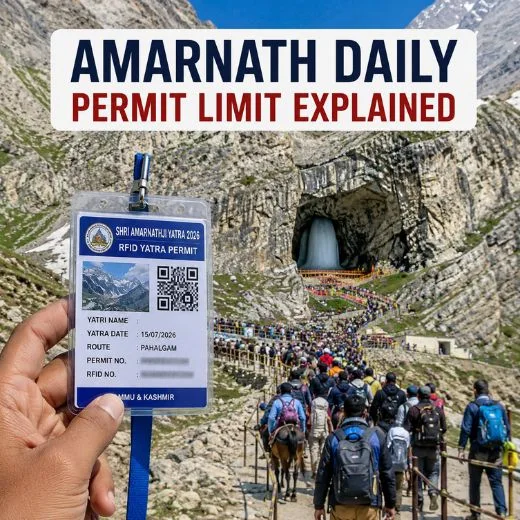
Every year, thousands of devotees plan the Amarnath Yatra with excitement, but many preferred dates sell out within hours or days. The Amarnath Shrine Board strictly controls the daily permit limit to manage crowds, ensure pilgrim safety, and handle weather risks in the Himalayan region. With limited slots, RFID tracking, and high demand during Shravan season, permits fill very quickly. Pilgrims who delay registration often miss their desired travel dates.
With limited daily entry slots, growing pilgrim numbers, RFID tracking rules, and high demand during Shravan season, permits disappear much faster than most people expect. Popular dates, especially weekends and holy occasions, face massive booking rush from pilgrims across India. If you are planning the yatra in 2026, understanding how the daily slot system works can help you avoid disappointment and secure your journey on time.
Shrine Board allows roughly 10,000 to 15,000 pilgrims per day across both routes combined. This isn't an arbitrary number the cave sits at 3,888 metres in a narrow glacial valley where trail space, medical teams, and emergency evacuation routes all have hard limits.
When a date hits that limit, it closes. No exceptions, no walk-in quota, no waitlist. You either book in time or you push to a later date.
The daily cap is split between two routes:
| Route | Daily Quota | Distance | Duration |
|---|---|---|---|
| Pahalgam | ~7,500 – 8,000 | 36–46 km | 3–5 days |
| Baltal | ~5,000 – 6,000 | 14–16 km | 1–2 days |
| Helicopter | Separate, limited | — | Half day |
Pahalgam fills first, every year. The traditional route, the scenic camps, the multi-day experience — people want it. Many pilgrims choose the traditional Pahalgam route pilgrimage experience because it offers a slower and more scenic spiritual journey. Baltal often still has slots when Pahalgam is completely gone.
If you're flexible on route, always check Baltal before assuming the yatra is out of reach. Helicopter bookings run on a completely separate quota through operators like Pawan Hans. Book those directly on the operator's site — not through SASB.
There are four steps, and they're all connected:
Honestly? Book the day registration opens, and have everything ready in advance.
That said, timing matters depending on which dates you want. The opening week and Shravan Purnima dates are the hardest — they sell out within hours. Mid-July weekdays have more room to breathe. Late August has better availability but the monsoon is active, so trail conditions get unpredictable.
One underrated tip: weekends fill faster than weekdays even in mid-season. If you have even two or three days of flexibility, a Tuesday or Wednesday start will be easier to book and less crowded on the trail.
Also worth checking — cancelled permits do get re-released. Mid-week, off-peak hours, Tuesday to Thursday tends to be when new slots quietly reappear. Not guaranteed, but worth a look if you've missed the initial window.
The portal is your best option, but it's not your only one.
Online (SASB portal) — Primary method, available 24/7 after registration opens. Always start here.
Authorised bank branches — J&K Bank, PNB, and YES Bank have been designated in past seasons. Useful if your internet is unreliable or you prefer in-person booking.
Offline counters in Jammu and Srinagar keep a small number of permits available at Yatri Niwas Bhagwati Nagar in Jammu. People queue early morning. Don't rely on this unless you're already in Jammu with no other option.
Registered tour operators — SASB-registered agencies hold a block quota for group packages. During peak season, many devotees prefer complete Amarnath travel packages for families and groups to avoid permit and hotel booking stress. If the open portal shows nothing, a registered operator might still have dates available.
One thing that needs saying clearly: showing up at base camp without a permit does not work. The RFID system enforces entry strictly. No valid permit means no entry, regardless of how far you've travelled to get there.
And please — verify your permit number on the SASB website before you travel. Fake permits are being sold online and in Jammu. A fake one gets you turned back at the checkpoint. There's no fix for that on the spot.
The RFID system directly enforces the daily permit limit on the ground. It links your permit number, name, and ID together. Officials scan your RFID card at every checkpoint and record each entry according to the date and route.
Losing it mid-trek isn't the end of the world base camp offices can replace it — but it causes delays you don't want in the middle of a mountain pilgrimage. Keep it in a zip pocket or on a neck lanyard, not loose in your bag.
The tracking also has a practical benefit people don't think about: if something goes wrong and rescue teams need to locate you, the RFID checkpoint data tells them exactly where you last passed through.
If the portal is fully booked and you're stuck, registered tour operators are often the only legitimate path forward. Pilgrims from eastern India often rely on guided pilgrimage tours from Kolkata with registration support for confirmed slots and smoother travel planning.
SASB allocates a portion of each day's quota to registered agencies for group tours. This allocation is separate from what's available publicly — so an operator can sometimes offer dates that show zero availability on the open portal.
Yes, packages cost more than booking directly. But if it's two weeks before the season and you've exhausted every other option, a legitimate package is far better than missing the yatra entirely.
Before you pay anyone, verify their name on the SASB website, ask them to show the actual permit with your name on it, and confirm the travel date and route in writing. If they're offering sold-out dates but can't explain their allocation clearly — walk away.
No. Permits are non-transferable and tied to your ID. You can cancel through the official portal for a partial refund depending on how early you cancel. The slot then goes back into the system.
Your permit is only valid for the exact date on it. Arriving late means you've missed your slot — there's no same-day rebooking at the checkpoint. Reach base camp the evening before your start date to avoid this.
For the first week and Shravan Purnima, be ready to book the moment registration opens — around 60 days before the yatra starts. Have your health certificate and ID details ready beforehand. These dates have sold out within a few hours in recent seasons.
Yes, helicopter operators manage their own daily capacity separately in coordination with SASB. They offer limited availability, handle weather-related cancellations regularly, and accept bookings only through their official websites.
RFID card, permit copy (printed or digital), the government ID you registered with, and your health certificate. Mobile signal on the trail is unreliable — carry physical copies in a waterproof pouch. A couple of passport photos in your bag can also save time at certain checkpoints.
Understanding, Amarnath Daily Permit Limit before the plan about your journey and save you from last-minute stress, rejected slots and unnecessary confusion during the Yatra season. Since daily permits are limited demand increases every year, early registration, proper document preparation and timely RFID collection have become extremely important for every pilgrim.
If you want a smoother and more organized pilgrimage experience, Epic Yatra can help you with Amarnath registration guidance, helicopter booking, hotels, transport, RFID support, and complete Yatra planning. Plan smart, register early, and begin your spiritual journey to Baba Barfani without last-minute hassle.