

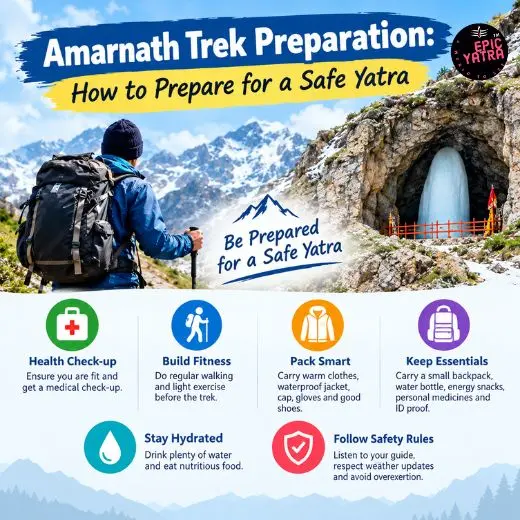
Nobody tells you this before your first Amarnath Yatra — the trek preparation is only half the journey. The other half happens in the weeks before you leave, in your living room, on your building's staircase, in the small daily decisions about what you eat and whether you went for that walk or skipped it. By the time you reach Baltal or Pahalgam, that preparation has already either served you or let you down.
The cave is at 3,888 metres. That number is worth sitting with for a moment and the Most of us live, work, and breathe at somewhere between sea level and 600 metres. The difference in oxygen between where you are right now and where that cave is — you will feel it with your first few steps on the route. Whether it stays manageable or becomes a medical problem is largely determined by what you did in the weeks before you got there.
Here is an honest observation: a significant number of pilgrims who struggle preparation on the Amarnath 2027 trek are not unfit people. They are office workers, teachers, homemakers, retired professionals — people of ordinary fitness who simply did not prepare for the specific demands of high-altitude trekking. They can walk two kilometres without breaking a sweat at home. At 4,000 metres, that same two kilometres feels like a different experience entirely.
The SASB runs medical camps along both routes because health emergencies are genuinely common. Altitude sickness, cardiac stress, breathlessness, exhaustion — these happen every season, and most of them are not random. They are predictable outcomes of insufficient preparation.
Start before Six to eight weeks, that is the window most experienced guides recommend, and it holds up because six to eight weeks is long enough to build real cardiovascular fitness without burning out before you even board the train.
Begin simple. Walk. Walk every day if you can, and gradually make those walks longer and a little harder each week. If you begin at 30 minutes, aim for 60 to 75 minutes by week four. The pace should feel like you are working — not gasping, not strolling, but the pace where conversation becomes slightly effortful.
A few things worth being specific about here, because generic fitness advice misses what this trek actually demands.
Walk with the bag you plan to carry. Once you know your pack weight — say 5 or 6 kilograms — start walking with it. Do this for the last two to three weeks of training. Carrying weight changes the effort level of every step, and finding that out for the first time on the trail is not the right moment.
Add breathing exercises to your mornings. Anulom Vilom — alternate nostril breathing — done for ten to fifteen minutes each morning genuinely trains respiratory efficiency. It sounds modest, but the difference at altitude is real. Many pilgrims who do this consistently report noticeably easier breathing on the ascent. It costs nothing and takes very little time.
Cycling and swimming are excellent supplements if you have access to them. Both build lung capacity with low joint stress, which matters if your knees or back have any existing sensitivity. Three sessions a week alongside your walking routine is plenty.
The one thing to avoid: intense training in the week immediately before departure. That last week should be lighter — shorter walks, more sleep, good food, no pushing. Your body needs to be fresh when it arrives, not already tired from a final burst of gym sessions.
This section is where most preparation guides stop being honest enough, so let's be direct.
Fitness helps at altitude, but it does not protect you from altitude sickness. People who run marathons get AMS. People who cycle centuries get AMS. Altitude sickness is not a fitness problem — it is an acclimatization problem, and the only real solution is time and gradual ascent.
What this means practically:
Do not arrive in Srinagar and push straight to the base camp the same day. Build a genuine rest day in Srinagar into your plan. Not a sightseeing day. A rest day — late mornings, light meals, short walks only, early bedtime. Your body starts adjusting to altitude the moment you land, and giving it 24 to 36 hours before the serious climbing begins makes a measurable difference to how you feel on days two and three of the trek.
Talk to your doctor before you go about Diamox (acetazolamide). It is a prescription medication that assists acclimatization and is widely used by high-altitude trekkers. Not everyone needs it, but if you have any respiratory history or have had altitude sickness before, this is a conversation worth having well before you pack.
The week before departure: keep it simple and digestible. Dal, rice, vegetables, fruits, roti. Cut heavy, fried, spicy food — your gut is going to be under more physiological stress at altitude, and arriving with an already-irritated digestive system adds an unnecessary layer of discomfort.
During the trek itself, eat small amounts regularly. Appetite typically drops at altitude — this is very normal and nothing to worry about — but you still need calories for hours of physical effort in cold conditions. Dry fruits, nuts, dates, chikki, energy bars: keep these in an outer pocket where you can reach them without stopping to unpack your bag.
Water is the most important thing you will consume on the route, and it is the thing most pilgrims manage worst. Cold weather suppresses the sensation of thirst, so many pilgrims simply do not drink enough. By the time you feel dehydrated at altitude, you have already been dehydrated for a while. Drink warm water proactively — before thirst arrives. Carry ORS sachets and use them.
The guiding principle: pack for the mountain's worst mood, not its average one.
Weather on the Amarnath route from srinagar can turn within an hour. A clear, sunny morning at Baltal can become sideways rain or sleet by noon. Pack for that reality rather than hoping it won't happen.
A few things that sound obvious but are regularly ignored:
1. Walk slower than feels natural, especially in the first hour. The biggest mistake pilgrims make is starting at their flatland pace. The energy expenditure at altitude is higher, and the pace that felt easy at home will tire you significantly faster up there. Start slow. Stay slow.
2. Keep your RFID card around your neck and your permit in an accessible pocket at all times. You will be asked for both at checkpoints, and fumbling through a bag at a gate in cold weather with tired hands is more frustrating than it sounds.
3. If you feel genuinely unwell — chest pain, confusion, severe breathlessness even at rest — go to the nearest SASB medical camp immediately. Do not wait to see if it passes. Medical staff are stationed along both routes precisely for this reason.
4. Do not trek the early morning Baltal sections alone. These segments are steep and dark before dawn. Travel with your group, and if you have separated from them, wait for other pilgrims to move with.
Some plain advice from everyone who has done this before you:
Take the Pahalgam route. It is longer, yes — three to five days one-way compared to Baltal's single long day — but the staged ascent through Chandanwari, Sheshnag, and Panchtarni gives your body time to acclimatize at each level. First-timers who choose Baltal for speed often find the single steep day genuinely overwhelming. The extra days on Pahalgam are not a compromise — they are part of what makes the experience meaningful.
The rest day in Srinagar is not sightseeing time. Use it to rest. This point appears in every guide and is ignored by a remarkable number of pilgrims who arrive with energy to spare and immediately fill that day with activities. The acclimatization benefit of genuine rest on that first day will show up clearly on day three of the trek. The sightseeing can happen on the way back.
Travel with a group or hire a local guide for your first Yatra. There is value in knowing the route from experience — where the tough sections are, where to stop, where the medical camps are located, which signs of your own body to take seriously. That knowledge is worth something and a first-timer does not have it yet.
Finally: the pony, palki, and porter support that is available along both routes exists for good reasons. Using it when you need it is not a failure of devotion. It is good judgement, and Lord Shiva has presumably never judged anyone for arriving by palki.
The evening before you begin — check this list once, calmly:
✅ RFID card around your neck
✅ Yatra Permit accessible in a front pocket
✅ Photo ID original on your person
✅ CHC original in your bag
✅ All medications accessible — outer compartment or top of bag
✅ Layered clothing ready, gloves and cap within reach
✅ Waterproof jacket not buried at the bottom
✅ Walking stick in hand or strapped to your bag
✅ Water bottle filled; ORS and snacks in outer pocket
✅ Emergency contacts written on paper (not just saved in your phone)
✅ Someone at home knows your route, camp names, and daily plan
That's it — preparation well, walk slow, and let the mountains do the rest, ready to book your Amarnath 2027 trek? Let Epic Yatra handle the planning while you focus on the pilgrimage.