

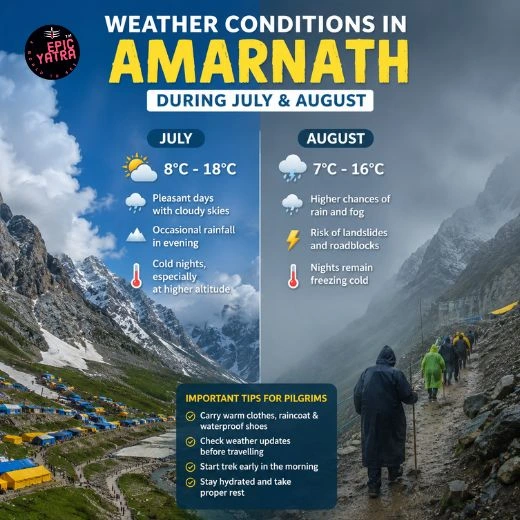
Weather conditions in Amarnath during the July and August changes very quickly and many devotees not prepare properly how challenging the Himalayan climate can become during the Yatra season. A bright sunny morning can suddenly turn into the freezing rain, dense fog or icy winds within a few hours. This sudden mountain weather is affects everything trekking speed, helicopter services, road conditions and even health at high altitude.
That is why every pilgrim should understand the weather conditions before starting the journey. During Amarnath Yatra 2026, travellers may face cold nights, heavy rain, slippery trekking paths, and low oxygen levels, especially near the holy cave area. Pilgrims who prepare properly with the right clothes, timing, and weather awareness usually enjoy a much safer and smoother spiritual journey to Baba Barfani.
Here's the honest picture:
July at the cave (3,888 m)
August at the cave (3,888 m)
The base camps at Pahalgam and Baltal is sit around 2,740 m and feel much warmer sometimes 22°C in the afternoon. The temperature feels much colder once you start climbing because strong winds increase the chill.
At Panchtarni or near the cave, a 12°C reading can feel like 5°C when the wind is blowing. August nights are noticeably easier than July, if cold nights worry you, August is the smarter pick.
Rain is the biggest disruptor on this route — not the cold.
July: Expect rain almost every afternoon. It usually starts building around noon and peaks between 1–4 PM. Heavy showers of 20–40 mm in an afternoon are common during peak monsoon.
August: Shorter spells, less intensity. Clear mornings become more frequent after the 10th. The trail dries quicker between showers.
This is what catches most pilgrims off guard.
The gap between afternoon warmth and night cold can be 15–18°C in a single day. You could be sweating through a climb at 2 PM and shivering in your sleeping bag by 10 PM.
Your body takes a beating adjusting to that swing — poor sleep, faster dehydration, and altitude sickness become more likely.
The fix is simple: layer up. Thermal base, fleece middle, waterproof shell. Add or remove as you go. One heavy jacket won't cut it here.
And remember — the coldest hours, 3 AM to 6 AM, are exactly when most pilgrims start their trek to reach the cave by morning. You'll be moving in the dark and in the cold. Dress for that, not for noon.
Same destination, very different weather experience.
If you want to watch the weather and move in a clear window, Baltal gives you that flexibility. Because of the shorter trekking duration, many yatris now prefer the short-route Baltal travel option for faster darshan access during unpredictable weather days If the forecast is rough on both routes, neither should be attempted. SASB will suspend movement anyway — that order exists for a reason.
Early July is the toughest. Monsoon is at full strength, trails are freshly opened, and snowfall near the cave is more common. Conditions improve gradually through July but it's still the riskier month.
The sweet spot most guides quietly recommend: 10 August to 25 August. Rain is less frequent. Mornings are clearer. The high passes are more walkable. Nights are cold but not brutal.
That said, early July has its own pull — fewer crowds, peak Shivling formation, and that raw, unspoiled feel of being on the trail before it gets busy. If you go in July, just pack heavier and watch the forecasts closely.
A few things that actually matter on the ground:
Three things altitude does that most people underestimate:
Less oxygen. At 3,888 m, you're getting about 60% of the oxygen you're used to. Simple climbing feels hard. Add cold wind and a loaded backpack and exhaustion arrives much faster than expected.
Strong UV even on cloudy days. The sun's radiation increases with altitude. Cloud cover doesn't protect you. Snow makes it worse by reflecting UV upward. Sunburn happens here on overcast days — SPF 50 is not optional.
Weather changes in 30 minutes. Clear sky at 10 AM doesn't mean clear sky at 1 PM. On this route, fast-moving storms are normal, not unusual. Always carry rain gear, no matter what the morning looks like.
Pack for every condition you might face in one day — not just the forecast.
One small tip that makes a real difference: keep your dry change of clothes in a separate sealed bag inside your pack. After a rain-soaked afternoon, that dry kit at camp is not a comfort — it's protection.
Experienced pilgrims is always start before sunrise because the 5 AM to 11 AM window is offers a calmer winds, clearer visibility and lower chances of rain. Mostly yatri's complete darshan and begin returning before afternoon weather changes make the trail slippery, colder and more dangerous. That is why camps start serving breakfast as early as 4:30 AM.
For a safer and more organized journey, many travellers prefer guided support with experienced trip coordinators, proper weather updates, and planned trek timings. Book your Amarnath Yatra with Epic Yatra and travel with better safety, comfort, and confidence during unpredictable Himalayan weather.
The cave is enclosed and blocks wind, so it feels slightly warmer — around 5°C to 10°C during darshan hours. But wait times can stretch to a few hours during peak season. Keep your layers on the entire time.
Yes, especially in the first two weeks. Snowfall above Panchtarni level is not rare even in mid-August. By late August it becomes much less likely — but always carry gear for it.
The cold altitude make it genuinely hard for older pilgrims, especially those with heart or breathing problems. Also Helicopter services from Baltal and Pahalgam to Panchtarni are available and worth considering. The SASB advises pilgrims above 75 to consult a doctor before registering.
The SASB releases daily bulletins on their official website. Your camp manager and ITBP personnel at checkpoints also have the same-day updates. Check before every single morning departure.
SASB halts movement on both routes during red-alert conditions — heavy snowfall, flash flood warnings, poor visibility. You wait at the nearest camp until clearance is given. Trying to move against that order is prohibited and genuinely dangerous. A weather delay is not wasted time — it's part of the journey.