
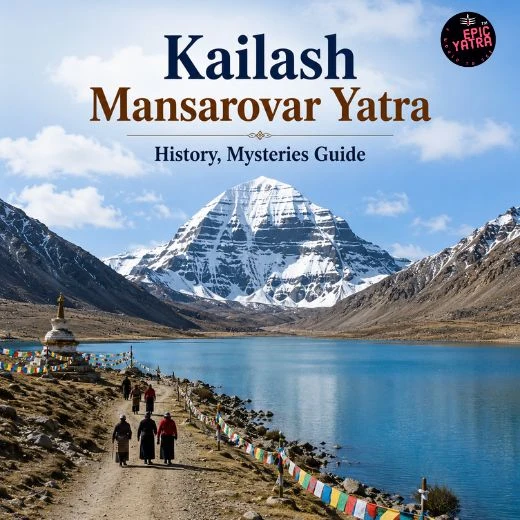
There are places in this world where you stop thinking and start feeling. Mount Kailash is one of them. Standing at 6,638 metres in the heart of Tibet, this four-sided peak has never been climbed — not because it's impossible, but because no one is allowed to try. It's considered too holy and the history of kailash mansarovar yatra In Hindu belief, Lord Shiva and Goddess Parvati is reside here.
The Shiva Purana, Skanda Purana, and Mahabharata all describe it as the mythical Mount Meru — the centre of the entire universe. Right below it sits in Lake Mansarovar. The name comes from Sanskrit — Manas (mind/consciousness) + Sarovar (lake). One dip in its waters, pilgrims believe, cleanses the karma of a whole lifetime.
The history of Kailash Mansarovar Yatra goes back much further than any organised religion or government route.
In the Mahabharata, the Pandava brothers trekked to Kailash after the Kurukshetra war — seeking salvation, not victory. They believed it was the doorway to Swarga Lok (heaven). That reference alone tells you this isn't a modern pilgrimage.
Tibetan Buddhists call it Kangri Rinpoche — Precious Snow Mountain. They've revered it for over 1,000 years as the home of Buddha Demchok, for Jains, it's Astapada where their first Tirthankara attained liberation. The ancient Bon people of Tibet go even further back, calling it the soul of the world.
In 1981, the Indian government formalised the pilgrimage through the Ministry of External Affairs via Lipulekh Pass, Uttarakhand. After COVID halted it for years, the route proudly resumed in 2025.
Kailash isn't just sacred — it's genuinely strange. Even scientists aren't sure what to make of some of this.
1. Nobody has ever reached the top. China doesn't permit climbing permits here, and rightly so — but teams that have even attempted a base approach report sudden weather changes and unexplained disorientation. The mountain seems to push people away.
2. Time moves differently here. Many pilgrims and trekkers report that their hair and nails grew at an unusually fast rate during their time near Kailash weeks of growth in just a few days. No clear scientific explanation exists.
3. It looks human-crafted. The mountain's near-perfect pyramid shape with four faces pointing exactly toward the four cardinal directions has made some researchers question whether this is entirely natural. Mainstream geology says erosion. Others aren't so sure.
4. The sun and moon lakes. From above, Mansarovar and Rakshastal look like a sun and a crescent moon. It's the kind of symmetry that makes you pause. Ancient traditions called it divine design. Make of that what you will.
Ask a Hindu, a Buddhist, a Jain, or a Bon follower — you'll get different answers, but the same reverence.
For Hindus, one Parikrama (full circle) around Kailash wipes out the sins of a lifetime. 108 rounds? That's moksha complete liberation. A bath in Lake Mansarovar is considered one of the most purifying things a person can do in their entire life.
Here's something that surprises most people: four of Asia's greatest rivers the Indus, Brahmaputra, Sutlej, and Karnali all begin near Kailash. Ancient seers saw this as the mountain literally feeding civilisation. Even modern geographers find this hydrological coincidence extraordinary.
And then there are the two lakes at its base. Mansarovar — peaceful, clear, freshwater, Rakshastal dark, saltwater, where Ravana is said to have done fierce penances to please Shiva. Two lakes, two energies, same mountain, It's a balance you can feel when you're standing there.
The season runs May to September, Each month has its own feel:
May–June: Fewer crowds, cooler air, some snow still on passes. Good if you want a quieter experience.
July–August: Peak season. The government Yatra runs during this window. More support and facilities, but also more people. Monsoon rains can affect Nepal-side roads.
September: Many experienced pilgrims say this is the best month. Clear skies, crisp air, mountain sharply visible. Crowds have thinned, It's a calm, beautiful time to be there.
Note: Avoid October to April entirely. Passes close, temperatures go extreme, and most facilities shut down.
Getting there is part of the experience. There are three main routes:
Via Lipulekh Pass (Uttarakhand, India): The official Indian government route via MEA and KMVN. Starts from Delhi, goes through Dharchula and Gunji, crosses into Tibet via Lipulekh. Around 22 days, in batches of 50. Resumed in 2025 after a long pause.
Via Kathmandu (Nepal): The most popular international option, Fly to Kathmandu, get your Chinese group visa and Tibet permit through a registered operator, then travel to Lhasa and onward. For many pilgrims, the Kathmandu gateway to Mount Kailash serves as the preferred starting point for this sacred journey. Takes 14–21 days.
Via Simikot–Hilsa (Nepal): The fastest route a domestic flight to Simikot, a short helicopter ride to the Tibet border, and you're in. Doable in about 10 days.
Can't make it to Tibet? You can now see Mount Kailash from Lipulekh Pass in India — even by helicopter from Pithoragarh. A darshan without crossing the border.
A few things that actually matter — from people who've done this:
Yes. The Uttarakhand route resumed in 2025 under MEA and KMVN. The Nepal route runs year-round through private operators. Check current status before booking.
Anyone with uncontrolled blood pressure, heart disease, asthma, diabetes, or serious lung conditions may be disqualified. A medical certificate is mandatory for all applicants.
No. It's never been summited. China doesn't issue climbing permits, and the mountain has remained untouched — intentionally — out of respect for its sacred status across four religions.
Three days for most pilgrims, covering 52 km. Some strong trekkers do it in two. The Dolma La crossing on Day 2 is the hardest part.
Hindu belief says it washes away the sins of an entire lifetime. Lord Brahma created the lake for divine rituals. Beyond belief — pilgrims of all faiths say standing beside it at 4,580 metres is one of the most moving experiences of their lives.
No. Tibet requires a licensed guide and group visa for all visitors the Indian government route also runs in supervised batches. Solo travel isn't permitted on either route.
The Kailash Mansarovar Yatra History is a timeless story of faith, devotion, and spiritual discovery. Revered by Hindus, Buddhists, Jains, and Bon followers, Mount Kailash continues to inspire millions with its sacred significance, ancient legends, and enduring mysteries whether you seek divine blessings, inner peace, or a deeper connection with nature and spirituality, this pilgrimage offers an experience unlike any other.
If you're planning this sacred journey, Epic Yatra can help make your pilgrimage smooth, safe, and memorable with expertly managed Kailash Mansarovar tour packages, permit assistance, accommodation, and on-ground support.