

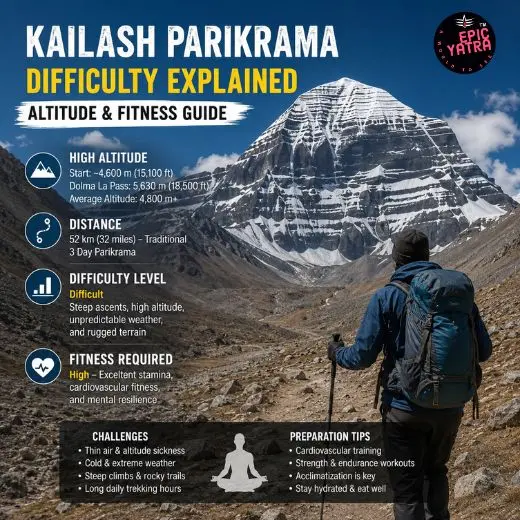
Talk to ten people who've finished the Kailash Parikrama difficulty, and at least eight will pause before answering how hard it actually was. It's not that they're being dramatic. It's that the honest answer is layered — yes, it's tough, and yes, most of that toughness has nothing to do with how fit you were going in. The Kailash Kora, as it's also known, is a roughly 52 km trek circling the base of Mount Kailash in western Tibet, usually completed over three days.
Hindus, Buddhists, Jains, and Bon practitioners have all been walking this same loop for centuries, each with their own reason — washing away karma, moving closer to moksha, or simply marking a once-in-a-lifetime pilgrimage. The reasons differ and difficulty doesn't discriminate by faith, the parikrama remains the most challenging stage of the sacred Kailash pilgrimage.
Strip away the spiritual weight for a second and look at the trek on paper, you're walking at an average altitude close to 5,000 meters. Through terrain that shifts from gravel valley to glacier moraine to exposed mountain pass, in weather that has zero loyalty to your itinerary, None of those things alone would be unmanageable. Stacked together over three days, they add up fast.
The trek starts and ends at Darchen (4,675m), already higher than most people have ever stood from there, the route runs through Tarboche, up to Dirapuk monastery, and eventually over the trek's defining obstacle.
If you ask anyone what made the Kailash Parikrama difficulty real for them, the answer is almost always the same two words - Dolma La Pass. Sitting at roughly 5,630 meters, it's the highest point on the entire route, and getting there means a steep, grinding climb that most groups start in the dark, often around 3 a.m., to beat the wind that picks up by afternoon.
The air at that height carries something like 50% less oxygen than sea level people who've never struggled with a flight of stairs in their life find themselves stopping every few steps just to breathe. The descent afterward isn't a reward, either — loose rock, sometimes old snow, and legs that are already done arguing with you.
This single day covers around 18 to 22 kilometers and eats up eight to twelve hours depending on your pace and group. It's the longest day, the hardest day, and by most accounts, the most spiritually overwhelming one too. On the way down, you'll pass Gauri Kund, a small frozen lake tucked into the descent — one of those quiet, strange moments that lands differently depending on how exhausted you already are.
Here's something worth saying plainly: 52 kilometers is not a long distance. People walk that in a weekend back home without thinking twice. What changes everything is altitude. Acute mountain sickness (AMS) doesn't care about your marathon time or your gym membership. Headache, fatigue, dizziness, shortness of breath, loss of appetite — these symptoms show up regardless of fitness level, because they're a function of oxygen, not strength.
Most experienced trekkers will tell you the same things: walk slower than feels natural, drink more water than you think you need, and don't push through symptoms hoping they'll pass on their own. Many pilgrims talk to their doctor beforehand about Diamox (acetazolamide) as a preventive measure — not a fix for ignoring acclimatization, but a tool alongside it it during the Kailash Parikrama.
This trips up a surprising number of first-timers, the standard route almost everyone does is the Outer Kora. The 52 km three-day circuit described above, open to the vast majority of pilgrims with the right permits. There's also an Inner Kora, a shorter but far more demanding route that goes closer to the mountain's base. Crosses even higher terrain and is traditionally reserved for pilgrims who've completed multiple Outer Koras first. Access to it is restricted and not guaranteed even if you ask.
If someone's telling you about "doing the Kailash Kora," they almost certainly mean the Outer route. That's the one worth preparing for.
No — and this is the part most people get wrong before they arrive. You don't need to be an athlete. What you need is a baseline of cardiovascular fitness and the ability to walk five to eight hours a day. On uneven ground without falling apart by the second day.
If you've got two to three months before departure, use them:
Start early: A couple of months of unglamorous, consistent walking will serve you better on Dolma La than one intense training week right before you fly.
Yes, regularly. Age isn't the deciding factor — overall health is pilgrims well into their seventies complete the Kailash Mansarovar Yatra every year. Often with pony or porter support on the tougher stretches. If you've got heart issues, respiratory conditions, or uncontrolled blood pressure. A conversation with your doctor isn't optional but plenty of people with manageable health conditions still go. With the right planning and a guide who knows what they're doing.
The best time for Kailash Parikrama runs from May to September, with the weather difficulty at its most stable. Many pilgrims specifically plan around the Saga Dawa Festival in late May or early June. When thousands gather for one of the most sacred dates on the Tibetan calendar. Though it also means bigger crowds and a bit less solitude on the trail.
Almost everyone who finishes says yes, and they tend to mean it in a specific way. Not a postcard-caption way there's a particular feeling — lungs burning, prayer flags snapping overhead. Kailash visible somewhere in the haze — that most people can't fully explain afterward. The difficulty isn't a flaw in the trip. For a lot of pilgrims, it's the whole point.
The Kailash Parikrama difficulty is hard, and no honest article should pretend otherwise. But hard isn't the same as impossible. Every year, fit twenty-somethings, out-of-shape forty-somethings, and grandparents in their seventies all make it around that mountain and come back different. What separates a miserable trip from a transformative one isn't raw fitness—it's preparation, pacing, and respecting the altitude. For a well-planned and hassle-free Kailash Mansarovar Yatra, connect with the experts at Epic Yatra.
Honestly, harder than it looks on paper. The 52 km distance sounds manageable — but you're walking at 4,600m to 5,630m altitude the entire time. The Dolma La Pass ascent is steep and the thin air makes every step feel like two. You don't need to be an athlete, but your heart and lungs need to be in decent shape.
Absolutely. Pilgrims in their 70s complete this yatra every year. What matters is your overall health, not your age or trekking experience. If the steeper sections feel too much, ponies and porters are available — especially around Dolma La Pass. Just get a proper medical check-up before you book.
May to September is your window. May and June are beautiful — cooler weather and the added spiritual energy of the Saga Dawa Festival. September gives you the clearest skies of the season. Avoid winter completely — the pass closes and temperatures become dangerous.
Yes — you cannot do this independently. Since Kailash is in Tibet, you need a Tibet Travel Permit, Alien's Travel Permit, and Military Permit. A licensed agency like Epic Yatra handles all of this for you. Plan for 15–20 days of processing time, so don't leave it late.
Start 2–3 months out. Daily walks of 5–10 km on inclines or stairs will build the stamina you need. Add squats and lunges for your legs, and spend time on breathing exercises — your lungs will thank you at 5,000m. Speed doesn't matter here; endurance does.
The Outer Kora is the standard 52 km circuit that all pilgrims do — this is what your package covers. The Inner Kora is a restricted, more technical route much closer to the mountain, traditionally only open to those who have completed 13 Outer Koras first. As a first-timer, you'll be doing the Outer Kora.