

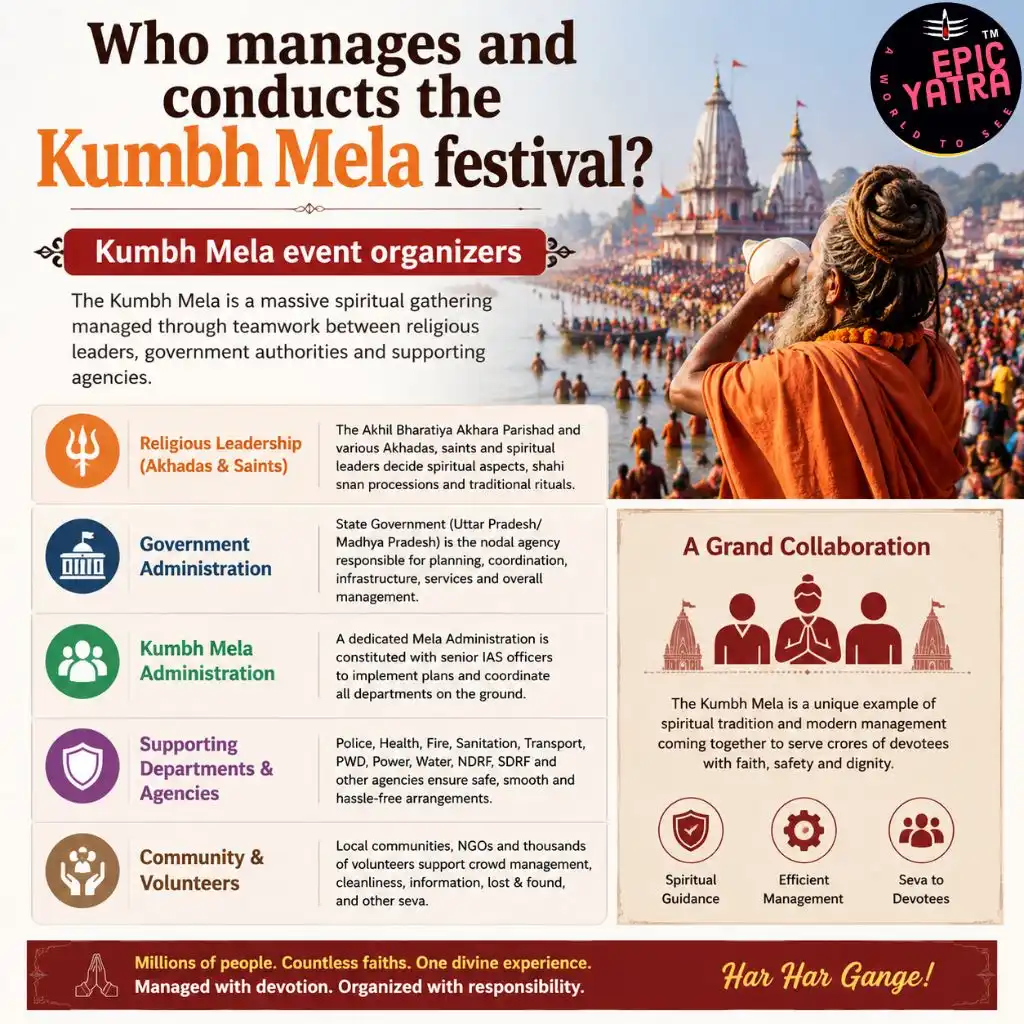
The Kumbh Mela is one of the biggest spiritual gatherings in the world, drawing millions of pilgrims, saints, and tourists. Moreover, behind this massive event is a highly structured system of governance with several authorities working together. In addition, from government agencies to religious boards and volunteers, an enormous level of co-ordination is required to run the Kumbh Mela event organisers efficiently.
Furthermore, different departments continuously manage security, transportation, sanitation, and crowd control throughout the festival. As a result, the Kumbh Mela operates smoothly despite the presence of millions of devotees.
Furthermore, these organisations ensure smooth crowd management, safety, sanitation, and spiritual arrangements throughout the festival. In addition, their combined efforts help maintain order and provide a peaceful experience for devotees. Travellers planning a sacred journey can also explore well-organised pilgrimage travel plans for a more comfortable experience during the grand event.
In addition, this article explains the roles and responsibilities of Kumbh Mela event organisers and how they successfully run such a large festival each time.
A Full Authority Overview
There is no one body that manages the Kumbh Mela. Instead, it is not something that one institution can take on alone. Moreover, each group assumes a particular aspect of planning, execution, and spiritual coordination. As a result, the system works like a well-oiled machine, with every part playing a vital role in ensuring safety, order, and smooth operation.
The state government has the most important role to play at the ground level for organising the Kumbh Mela. It is responsible for overall planning, infrastructure development, law and order and public safety.
Key responsibilities will include:
The state government’s leadership is essential to the large-scale execution of the event.
Additionally, the Kumbh Mela event organisers constitute a special administrative unit for the management of the festival. As a result, this body serves as the central command center for all preparations.
It is responsible for the following:
This structure guarantees continuity and smooth execution during the whole event period.
Moreover, the central government is actively supporting the event in terms of funds, infrastructure support, and inter-state coordination. In fact, the Kumbh Mela is considered a national-level event as it draws people from across the country. Additionally, various ministries work together to ensure smooth arrangements. Therefore, the festival receives large-scale administrative and logistical support.
Its contributions are:
This partnership improves the overall management framework.
The executive arm of the Kumbh Mela is the district administration. It implements plans on site and ensures that all services are running well.
Main role:
They are the direct link between planning authorities and the on-ground execution.
The Akhara Parishad is the peak body of all major monastic groups participating in Kumbh Mela. It is important in the management of religious traditions and rituals.
Include roles:
This method preserves the respect and orderliness of spiritual customs.
There are 13 major Akharas representing different spiritual traditions in Hinduism. Moreover, each akhara follows its own unique practices and discipline. In addition, every akhara is led by respected spiritual leaders and saints. Furthermore, these organisations play an important role during the Kumbh Mela celebrations.
Their duties are as follows:
They add a kind of diversity and spiritual depth to the Kumbh Mela.
Each Akhara has the system of Mahant and Panch to look after the internal affairs. Also this system provides for discipline and decision-making in the monastic community.
Functions are:
This internal governance keeps the spiritual groups in order and in communion.
The temple trusts also take on a caring role during the Kumbh Mela, offering food, stay facilities and spiritual services to the yatris.
They contribute:
They help to make sure that no visitor is without basic support.
Moreover, the local municipal bodies celebrate the festival with cleanliness and civic infrastructure, while also ensuring better public facilities for visitors.
They are responsible for:
This work is vital to keep the environment clean and also safe for millions of visitors.
Volunteers are one of the most important but least visible components of the entire system. They help the pilgrims and help the administration teams.
They assist with:
Their dedication gives the massive event a human feel.
The success of the Kumbh Mela lies in the smooth coordination between all the authorities. Moreover, to ensure smooth operations, regular meetings, communication systems, and control rooms are in place. Additionally, different departments work together continuously. Meanwhile, officials monitor crowd movement and safety arrangements in real time. As a result, pilgrims experience better management and more organised services throughout the festival.
The main coordination methods are:
This neat system allows millions of people to gather peacefully and safely.
It’s clear that accountability is divide with so many agencies involved. Each authority is responsible for its domain, ensuring a quick response in emergencies.
For example:
The division is helpful for solving problems quickly and efficiently.
For pilgrims, the Kumbh Mela is a spiritual and logistical experience. A smooth visit also needs careful planning.
Main points:
Temporary accommodation zones are often set up with comfortable arrangements for visitors to stay in well-managed setups during the festival period. These pilgrim stay facilities and spiritual lodging camps provide convenience, safety, and easy access to the holy gathering.
The Kumbh Mela is more than a religious congregation – it is a feat of coordination between administration, spirituality and community involvement.Moreover, each has a vital role in its success, as government officials, volunteers, and spiritual leaders work together smoothly.
Moreover, this extraordinary partnership is a testament to how faith and organisation can come together to successfully manage one of the largest human gatherings on Earth. Furthermore, It highlights the power of coordination, dedication, and cultural unity. Consequently, millions of pilgrims experience a safe, organised, and spiritually enriching event while also exploring guided spiritual tour options for the upcoming sacred gathering in Nashik.
A. It is jointly organised by state governments, central government agencies, district administration and spiritual bodies such as Akhara Parishad.
A. Akharas are responsible for the religious rituals, processions and spiritual activities during the festival.
A. Moreover, the main responsibility for crowd management and safety lies with district administration and police forces.
A. Yes, during the festival temporary camps and tented accommodation are arranged for visitors.
A. The millions of people attending mean coordination is therefore crucial for the safety, cleanliness, and smooth running of all services.
Discover divine journeys and spiritual adventures with Epic Yatra.