

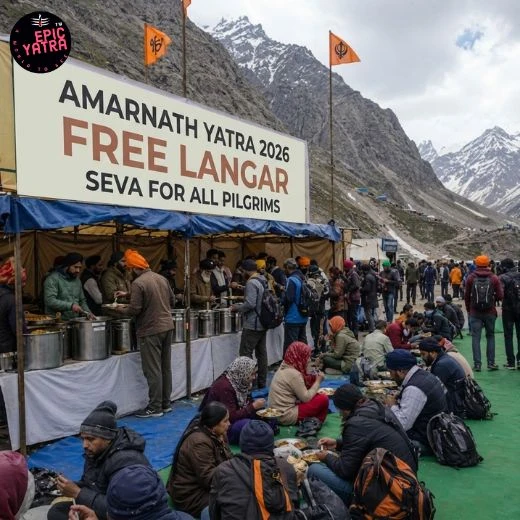
Ask any Amarnath pilgrim what surprised them the most during the journey. Most people won’t talk about the cave or the ice Shivling first. They’ll talk about the person who handed them a warm cup of tea at 13,000 feet. That's the magic of langar facilities on this amarnath yatra is unexpected, deeply human, and honestly one of the most moving parts of the whole experience.
If you're planning your trip and wondering what free services are available on the route, this guide covers everything practically — where the langars are, what they serve, when they're open, and a few tips from people who've been there.
The Amarnath route isn't a casual walk and you're dealing with thin air, steep climbs, sudden rain, freezing winds and a body. That's burning energy faster than usual because of the altitude, by the time most pilgrims reach the midway points. Their legs are heavy and their energy is dropping.
The importance of langar is not just as a source of food, but it is also a true moment of human connection. Pilgrims who travels for more hours to set up a camp, wakes before sunrise, and cooks for thousands of strangers they may never see again. It puts your own efforts perspective, for pilgrims traveling from Bangalore, with tight budget that also removes a real financial worry.
And for old or unwell pilgrims, the medical support at several langar camps has genuinely been life-saving. This isn't an exaggeration at these altitudes, having oxygen and a trained volunteer nearby matters enormously.
The food is simple, hot and filling which is exactly what your body needs mid-trek. Most camps serve dal, rice, khichdi, roti, sabzi, and poha. Tea runs almost all day at most stops. Some of the bigger camps organized by larger trusts go further — halwa, kheer, dry fruits, even glucose drinks.
Note: No token, no registration, no payment—you simply sit, eat, and move on in the Langar Facilities in Amarnath Yatra.
Most major langars camp have tented areas where pilgrims can sit or lie down for a while. On the Pahalgam route especially, where the trek spans multiple days, having a proper rest stop makes a real difference. If the weather turns bad — which it does, often — these tents become genuinely important. Some camps also provide blankets, particularly at the higher-altitude stops.
This is the part people don't always know about until they need it. Multiple langars camps, mainly the important and well-arranged near the Panchtarni and Sheshnag, have the first aid stations. Oxygen cylinders, basic medicines, and volunteers trained for altitude emergencies.
If someone in your group feels the dizzy, If you get a continuous headache or have difficulty breathing. Don’t wait get to the nearest langar camp.
The Baltal route is short roughly and 14 km one way distance but it's steep and physically demanding. Langar stops are here located at the points where the pilgrims need them most:
Baltal Base Camp — Multiple langars right at the start. Tea and breakfast are usually ready well before sunrise for early risers.
Domail — A natural rest point mid-route. Meals are served through most of the day here.
Sangam — Near the confluence area before the final stretch to the cave. Warm food and chai available.
Many pilgrims who opt for helicopter-based shrine visits at Baltal side, making these langars their first experience of the route's hospitality.
This is the classic and longer route, but more gradual and spread over 3 to 5 days, depending on your speed. The multi-day nature, langars are here more clarify and feel more like camps than quick stops:
Pahalgam Town — Langars begin right at the base. A good place to eat before the trek starts in earnest.
Chandanwari — About 16 km from Pahalgam, it is first big stop here. Expect proper meals here.
Sheshnag — The high-altitude lake camp. Langar here is a real morale booster, especially with the landscape around you.
Mahagunas Pass (14,500 ft) — The highest point on the route. Even basic tea here feels like a gift.
Panchtarni — The last major halt before the cave. Some of the best-organized and largest langars on the entire route are here.
Pilgrims undertaking the multi-day traditional Pahalgam trek really come to rely on these stops — by day two, you know exactly where the next langar is and you plan around it.
Panchtarni deserves a special mention. It's where both routes meet before the final push to the cave, which means it has the highest footfall of any stop on the route. The langars here are large, well-stocked, and run by some of the most organized groups — including Radha Soami Satsang Beas and several state-specific trusts. Medical support is strongest here too.
Sheshnag, is sitting a beside stunning glacial lake at around 11,700 feet. One of those places where you stop not just because you're tired but because the view stops you anyway. The langar camps here tend to be larger than what you'd expect given the location. At Panchtarni, basic camp facilities are also available for pilgrims, including langar services, temporary resting tents, medical aid, and support arrangements for onward journey towards the Holy Cave.
Langars is generally follow the movement of pilgrims, so they open early and close late:
At major camps during peak season, some langars operate throughout the night. Don’t expect this at every stop; a practical rule is to eat whenever you find a langar. Mainly at the higher altitudes where the next stop could be far away.
The scale of the langar network on this route is genuinely impressive when you stop to think about it. These aren't government programs — most of it runs on donation, devotion, and voluntary labor:
A few honest, practical things worth knowing before you go:
When people talk about langar facilities in Amarnath yatra, they usually jump to "free food." But the actual impact goes deeper:
Yes, it is entirely free with no exceptions and langar is offered as a free seva, a form of selfless service, and is open to every pilgrim regardless of background or religion.
Dal, rice, khichdi, roti, sabzi and tea are the standard, standard camps are add sometimes halwa, kheer, dry fruits, or kadha (herbal drink).
At major camps like Panchtarni and Baltal base, some langars do run through the night during peak season. But this varies — don't rely on it at every stop. Carry your own supplies as backup.
Many camps are carry the basic first aid, oxygen cylinders and altitude sickness medicines. Major camps at Panchtarni and Sheshnag, usually have doctors or trained paramedics is available during peak season.
Get in touch with groups such as Radha Soami Satsang Beas, SASB, or a nearby Hindu Seva Samiti well before the yatra season. Spots fill up, and preparation is starts in advance months volunteering is here considered among the highest forms of pilgrimage service.
Honestly, no travel guide fully prepares you for the langar facilities on the Amarnath Yatra. You read about it, you expect it — and then someone hands you a hot bowl of dal at 13,500 feet and something about it just gets to you.
If you're planning your own yatra this season, don't just plan the route and the experience. Choose the right package with Epic Yatra to understand what the trail demands, and trust that the yatra will take care of you in ways you didn't expect.