

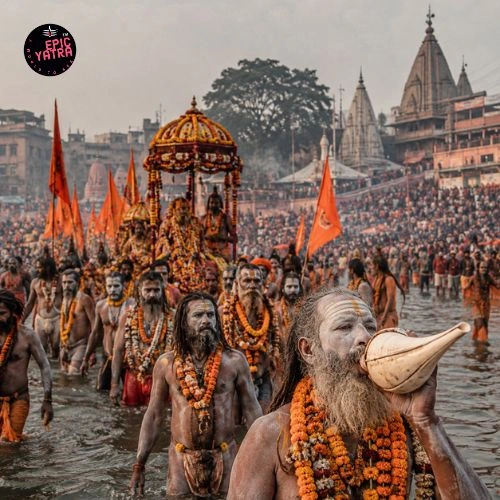
The Nashik Kumbh Mela Akharas is not just about millions of people taking a holy dip in the Godavari. At the heart of the festival are the akharas — ancient monastic orders of sadhus and sanyasis.Naga saints who lead the entire event with their processions, discipline, and centuries-old customs.
If you are planning to travel to Nashik for the upcoming Simhastha Kumbh, understanding the akharas will make your trip far more meaningful.
This guide walks you through everything about Nashik Kumbh Mela akharas.Their history, types, rituals, and how you can experience them respectfully.
An akhara is a religious and monastic organisation of Hindu ascetics, sadhus, and Naga saints, built around shared spiritual practices, experts, and traditions.
The word "akhara" originally meant a wrestling arena or a place of training, but over time it evolved into a term for organised groups of holy men who train in both spiritual and physical discipline.
At the Nashik Kumbh Mela, akharas serve as the central religious authority. They decide the bathing order, lead the grand processions, and take the first holy dip in the sacred Godavari before general pilgrims. If you plan your Nashik Kumbh trip in advance, you can witness these sacred rituals while enjoying a smoother and more organised pilgrimage experience.
Every akhara has its own flag, deity, chief mahant (head), and disciples, earning deep respect from devotees across India.
The akhara system began over a thousand years ago. Many traditions credit the 8th-century philosopher Adi Shankaracharya with organising ascetics into structured monastic orders to protect Hindu dharma during a time of religious and social change. Over the centuries, different sects established more akharas, creating the system of thirteen recognised akharas that continues today.
Nashik has been one of the four sacred sites of the Kumbh Mela for generations, along with Haridwar, Ujjain, and Prayagraj. The city's connection to the Godavari River and to the Ramayana (Lord Rama is said to have bathed here during his exile) gives it a unique spiritual weight. Akharas have travelled to Nashik for the Simhastha Kumbh for generations, carrying forward rituals passed down through their experts.
Akharas were not just spiritual gatherings — they served several important purposes.
Even today, akharas continue this role — they train sadhus, manage ashrams, and take the lead in organising the massive logistics of Shahi Snan.
Broadly, the akharas are divided into three major spiritual traditions.
Shaiva Akharas
These akharas worship Lord Shiva as the supreme deity. They include some of the oldest and largest orders, and many of their sadhus are Naga sadhus, recognised by their ash-smeared bodies and minimal clothing. Shaiva akharas typically bathe at Trimbakeshwar's Kushavarta Kund, near the source of the Godavari.
Vaishnava Akharas
These akharas follow Lord Vishnu and his various forms. Known as Bairagi akharas, their sadhus generally wear saffron robes and carry tilaks on their foreheads, representing their devotion to Vishnu. In Nashik, Vaishnava akharas are closely associated with Ram Kund in Panchavati.
Udasin Akharas
Founded in the tradition linked to Nanak's elder son, Sri Chand, the Udasin akharas blend elements of asceticism with a distinct philosophical outlook. They maintain their own akhara structures and participate actively in the Shahi Snan procession, though in smaller numbers compared to Shaiva and Vaishnava orders.
There are 13 recognised akharas that take part in the Kumbh Mela, generally grouped as follows:
Shaiva Akharas (7): Juna Akhara, Niranjani Akhara, Mahanirvani Akhara, Atal Akhara, Avahan Akhara, Anand Akhara, Agni Akhara
Vaishnava Akharas (3): Nirmohi Ani Akhara, Digambar Ani Akhara, Nirvani Ani Akhara
Udasin and Nirmal Akharas (3): Bada Udasin Akhara, Naya Udasin Akhara, Nirmal Akhara
Each of these orders arrives in Nashik with its own camp, disciples, elephants, chariots, and flags, making the akhara procession one of the most photographed moments of the Mela.
Shahi Snan, now also referred to as Amrit Snan, is the royal bathing ceremony and the most significant ritual of the entire Kumbh Mela. Akharas play the central role in this event:
This is why timing your visit around the Shahi Snan dates is so important if you want to witness it.
The true spectacle of the Kumbh—and also why early planning matters. Explore stay options in Nashik in advance, as these are the days when the city experiences its heaviest crowds and accommodations fill up quickly.
The procession to the river follows a fixed and dramatic sequence:
Watching this procession is one of the most powerful experiences of the Kumbh Mela, and many pilgrims plan their entire trip around being present for it.
Naga sadhus are perhaps the most striking figures at any Kumbh Mela. They belong primarily to the Shaiva akharas and undergo a long, rigorous process of initiation that can take years. Their lifestyle involves renouncing worldly possessions completely, including clothing, and dedicating their lives entirely to meditation, austerity, and spiritual practice. If you want to witness their traditions and rituals up close, plan your sacred journey in advance to ensure a smooth and well-organised pilgrimage experience.
Nagas are considered the "warriors" of the akharas, historically trained to protect dharma and the akhara's interests.
Their dramatic appearance during the Shahi Snan procession — ash-smeared skin, matted hair, and traditional weapons — draws enormous crowds of pilgrims and photographers alike.
For devotees, the presence of akharas transforms the Kumbh Mela from a large gathering into a deeply sacred event. Their rituals further purify the river, and devotees consider visiting an akhara camp or witnessing their prayers highly auspicious.
Many pilgrims seek blessings from mahants, attend religious discourses inside akhara camps, and use this time for reflection, fasting, and spiritual practice known as Kalpavas.
The akharas preserve ancient Hindu monastic traditions and pass them down from one generation to the next, keeping the lineage alive.
If you're travelling to Nashik for the Mela, here are some simple ways to be respectful:
The akharas are truly the soul of the Nashik Kumbh Mela. Without their processions, rituals, and centuries of tradition, the Mela would lose much of its spiritual depth.
Whether you visit for devotion, curiosity, or to witness one of the world's largest religious gatherings, understanding the role is key.
Akharas helps you experience the Kumbh Mela on a much deeper level.
If you are planning your trip, it is worth arranging your travel and stay — from tented camps near the ghats to comfortable rooms further out — well ahead of the main bathing dates.
So you can focus on soaking in the spiritual energy of Nashik rather than worrying about logistics once you arrive.
The 13 recognised akharas belong to the Shaiva, Vaishnava, and Udasin traditions.
Yes, the public can watch the procession, but authorities reserve certain areas near the ghats for akharas and officials during the actual bathing window.
This is a mark of spiritual seniority, recognising their role as guardians of religious tradition and their centuries-old right established through the Akhara Parishad.
During Shahi Snan, accommodation near the ghats fills up quickly. Book your stay early to get a comfortable and convenient place in Nashik.
The same 13 akharas join both Kumbh Melas, but Nashik and Haridwar have different bathing ghats, traditions, and procession routes. Embark on a memorable spiritual journey with Epic Yatra.