

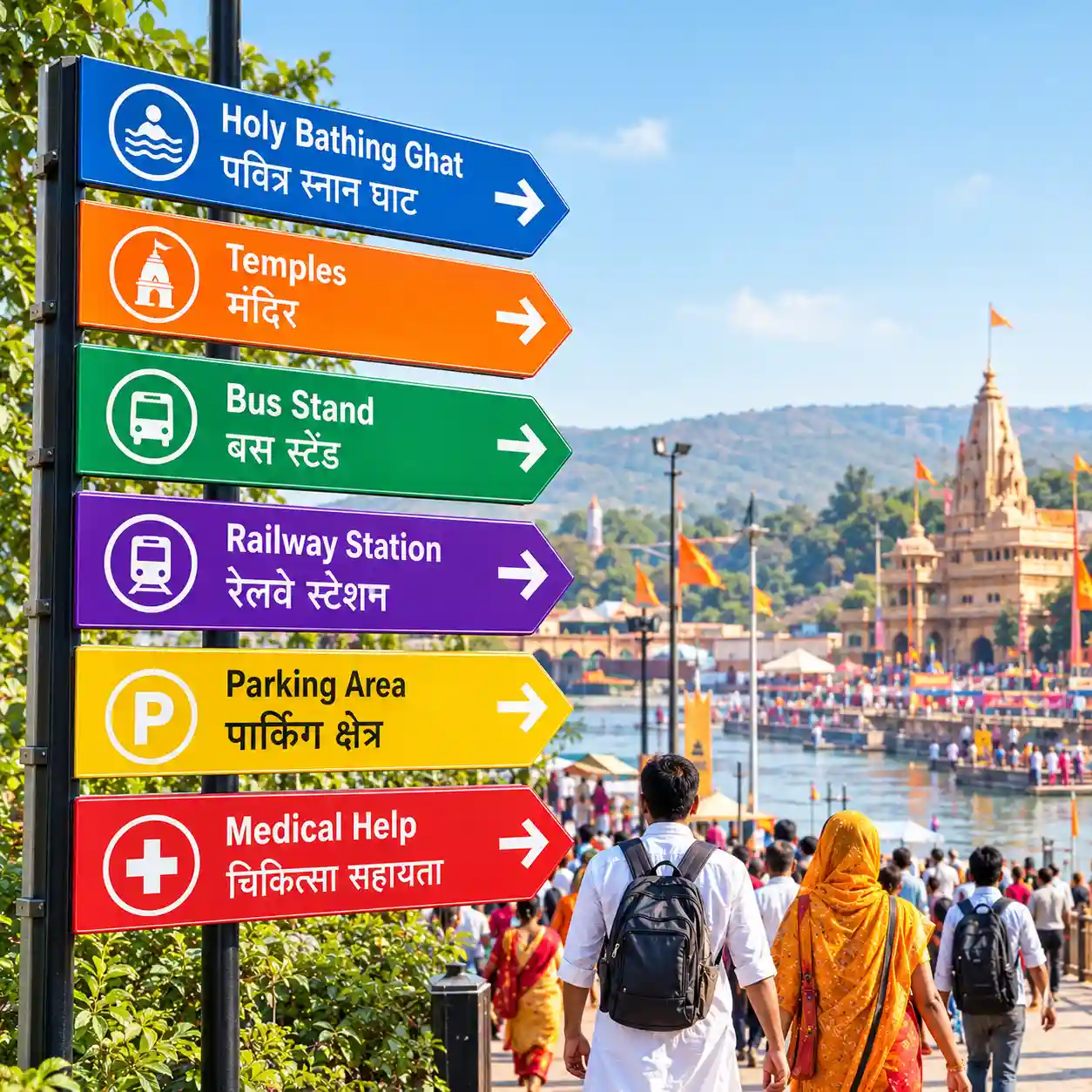
The town of Nashik is a major religious centre in Maharashtra. During the Kumbh Mela, thousands of devotees visit the city to bathe in sacred waters, offer prayers, and seek God's blessings. Nashik Kumbh Mela signboards can help these pilgrims find the correct roads, bathing areas, and entrance gates. Many visitors also travel to nearby temples and holy sites. However, large crowds can make navigation difficult.
Clear directions can help pilgrims move around the city more easily. Colour-coded signboards make this task simpler by using different colours to guide visitors towards important locations. Instead of reading lengthy instructions at every intersection, pilgrims can follow the signs to reach their destinations.
These signboards can help visitors identify key routes, understand directions, and avoid unnecessary confusion. They can also support smoother crowd movement during peak bathing periods.
Colour-coded signs use different colours to guide visitors to routes, temples, and transport points. Simple words, arrows, and symbols make directions easier to understand. Authorities can choose colours based on local traffic and crowd needs. These signs also help first-time visitors and people who speak different languages.
The main features of effective colour-coded signs include:
Together, they may assist the pilgrim or visitor in finding their way around.
Clear directions can also help pilgrims reach their booked stay more easily. Visitors can explore comfortable places to stay in Nashik during the Kumbh Mela and choose an option that suits their travel needs and budget.
The Nashik Kumbh Mela signboards bring many people to Nashik, from all across India. Many of those who come to Nashik during this time are reaching the city for the first time. Therefore, they may not be familiar with the local roads, where the temples are located, or how to get to the river.
Crowded streets will make finding your way around much more difficult. When the road is congested, people will probably have trouble asking for directions.
Well-planned signage can address several common problems, while choosing suitable pilgrimage tour options can help visitors organise their travel and stay more easily.
First-time guests could have difficulty finding key locations. They may use the incorrect path or expend additional time seeking the right entrance.
The use of colour coding on nashik kumbh mela signboards may be able to give visitors a simple visual aid. They will be able to follow the same colour of sign along a specific path to their desired location with less difficulty.
Road intersections may get confusing with various roads going to different places. Signs that are clear and have arrows will let people know what road they need to go on.
These signs may be placed prior to major intersections by authorities. This provides drivers with an adequate amount of time to select the proper route.
Crowds are large, they need directions so that they will be able to get in and out of the venue safely. Signs help people find their way to the right doors to enter and exit.
In addition, these devices can be used to separate pedestrian walkways from vehicular traffic when required. These devices can decrease unnecessary travel between congested locations.
Most people who come to a place of worship or other location that holds religious events would prefer to be able to focus on prayer and worship instead of having to look around for where to go. Good signage can assist these visitors in finding their way to where they need to be, without needing to stop at every turn.
This is particularly helpful for families, older people, and those travelling with children.
Nashik Kumbh Mela signboards: all routes that have been assigned a specific colour should maintain consistency of that colour. These colours should be identifiable at all times while people are travelling on these routes.
The authority can take into account the different kinds of routes to help plan out how they will display their signs.
The many devotees that travel to Nashik to have a holy dip in the designated rivers will find that during the major bathing periods, these designated river areas can become quite crowded.
Signs can help guide pilgrims to acceptable bathing paths and access points. Signs can also indicate where to exit, and other available options for walking.
The signs should use simple wording, clearly defined arrows and easily identifiable symbols.
There are many significant religious places to visit in Nashik. After or prior to performing the river ritual, visitors can choose to explore these religious locations.
Signs that give directions will allow pilgrims to get to those places in a more direct way than if they had taken some other route.
Useful information may include:
These instructions must be updated by the appropriate authority each time there are changes made to the way traffic is organised or how people gain entry into a particular area.
Pilgrims arriving in Nashik via train or bus will require clear directions to designated areas for transportation, walking routes, and nearby travel assistance upon arrival in the city.
The use of colour coded signage will allow for connection between the primary entry points and the main visitor attractions. In addition, the use of colour-coded signage will assist the traveller in identifying the designated drop-off and pick-up locations.
On the other hand, it will make on-the-go travel much easier, especially if you have to carry bags or go on vacation with your family.
Around busy pilgrimage sites, both private vehicles and buses can contribute to an increase in traffic. When there are clear parking signs, they can help drivers find their way to designated parking lots.
When there is a lot of traffic on a road, separating the direction of vehicle travel from pedestrian travel will make it less confusing.
The authorities must provide information on which roads are off limits to vehicles, what the requirements for entering these areas with a vehicle are, and where there are pedestrian-friendly routes.
A sign's placement is as critical as its design. No matter how well a board is designed, if people can't see it when needed, it won't be of much use to them.
Authorities can consider installing signs at the following locations:
Signs must be visible prior to taking a turn or changing directions. By using the same colour and icon as often as possible throughout the area where you are providing direction, you will encourage people to remain on the proper course.
Authorities should be inspecting these signs at all times. Poor visibility due to dust, rain, inadequate lighting and short-term installations can prevent people from seeing where they need to go.
Nashik has many pilgrims from different states speaking various languages. Thus, the signs need to be clear so all these pilgrims can understand what they are trying to say.
People who are on the move through busy city centres may find that long sentences can create confusion for them. Instructions should be short, so they can be read easily and quickly.
Where feasible, signage should be available in Marathi, Hindi and English. Additionally, depending on the requirements of visitors, authorities may wish to add other languages to the signage.
Symbols allow people to get direction and not have to read each individual word. For example, an arrow, railway symbol, bus icon, or toilet symbol can give you some quick and helpful information.
The design should be kept simple. If you have too many different colours, icons and instructions on your board, it could lead to confusion.
Some of the religious acts and the movements of pilgrims can still be done after dark. The signs used for these purposes should be able to be seen when there is little light.
The visibility of traffic signs may be improved by using reflective material, appropriate lighting and highly visible letters. It is also recommended that local authorities verify that other vehicles, trees, or other objects are not blocking the sign.
Route alterations may be made due to crowded conditions, safety regulations, and/or area road closures. Outdated route guidance can lead people toward closed roads.
authorities should check important signs and update them when arrangements change.
Physical signage is still relevant today, however, digital technology will continue to be a valuable resource for guiding people. Combining physical signs with digital information will assist individuals in planning how they get from point A to point B.
QR codes may be added to some signs. When visitors use their phones to scan the code, they will have direct access to official routes, information on public facilities and updates about current travel conditions.
The linked information must be sourced from an authority. It also has to function effectively on a mobile device, and use straightforward language.
Digital maps can assist visitors with finding where they are right now and locating other nearby services. Updates from the government can also provide information on road closures or temporary route changes.
In addition to providing digital direction assistance for those who do not possess a smartphone or have poor connectivity to the Internet, the use of digital directions will provide support to physical signs in lieu of replacing those signs.
Help centers can offer route maps and respond to queries from visitors. Personnel can assist individuals who find it difficult to read signs, or require assistance for specific travel needs.
The better we are able to clearly communicate with each other (such as help desks, traffic officials, etc.) will ultimately lead to a better overall experience for our visitors.
Safety needs to be one of the top priorities during large religious events. Simple signage that gives clear directions will allow people who attend these events to stay out of restricted zones and use only designated paths.
Signboards may also show emergency information and instructions on how to find emergency medical treatment.
Important safety messages may include:
Authorities should place emergency signage so that it is visible to visitors. They should also use consistent symbols and clear language.
Older people, young people, and visitors who have a disability may require extra assistance. It is important to give adequate attention to the creation of accessible walking paths and providing information about where to locate appropriate facilities.
Visitors may want to plan nashik trips in advance, and use the official direction provided, to help facilitate their travels.
Here are some useful tips:
Review Official Updates: Review travel advisories and route information prior to departure.
Walk on marked trails: Walk along designated walking trails and pay attention to signs placed at trail intersections.
Find out where you are going to arrive, where you want to go and what support services are close by.
Charge your phone: Your charged phone will allow you to view maps and call your family.
Be together as a group: Have a place where you will meet if you get separated from your family.
Plan for extra travel time: crowds and/or traffic restrictions could impact how long it takes you to get somewhere.
Pay attention to the directions given by the authorities: In order to control the number of people in an area and to ensure everyone's safety, the local authorities will make adjustments to the routes that people use.
Seek assistance if necessary: Contact authorized personnel if a sign is difficult to understand or a route appears to be blocked.
These simple steps can help visitors navigate the city with greater confidence.
Nashik Kumbh Mela signboards can make a real difference for pilgrims visiting during the Kumbh Mela. They help people find the bathing areas, temples, transport points, parking facilities and other important places without constant confusion.
The best system keeps things simple, with clear colours, readable text, bold arrows and consistent directions. Multilingual information, visible safety messages and regular updates make it stronger still. Physical boards and digital tools can work well together, as long as authorities keep the directions accurate and accessible to every visitor.
With careful planning and good execution, clear signage can reduce confusion, support more organised crowd movement and let pilgrims concentrate on the reason they came in the first place: their spiritual journey.
Before travelling, visitors should check official announcements and follow local authorities’ instructions for the latest route information.
Ans. They’re signs that use different colours to guide people towards specific destinations. Most also include arrows, symbols and short instructions to keep things easy to follow.
Ans. They help visitors identify routes, find important places and follow the designated entry and exit points. In crowded areas, clear directions can cut down a lot of confusion.
Ans. A first-timer can follow one marked colour instead of asking for directions again and again. That makes turns easier to spot and destinations easier to reach.
Ans. Good locations include railway stations, bus stops, road junctions, parking areas, religious sites, pedestrian routes and public help centres.
Ans. Yes. Marathi, Hindi and English can help a large number of visitors understand directions, and other languages can be added when needed.
Ans. They can. QR codes can connect visitors to official maps, route updates and information about public facilities. Physical signs should still stay in place for people who don’t have smartphones.
Ans. They can guide visitors towards approved routes, mark restricted areas and point to emergency assistance and medical help when it’s needed. EpicTirth makes every journey memorable.