

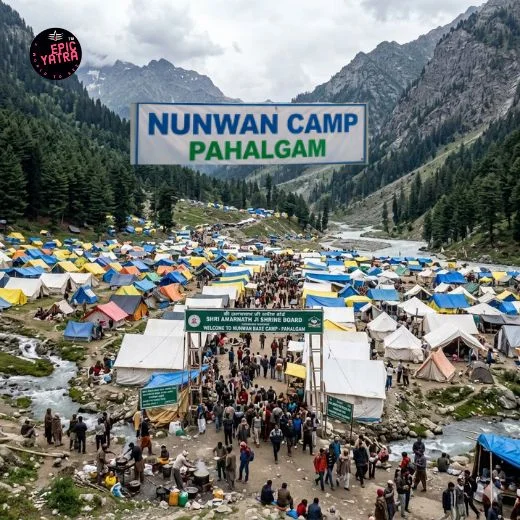
If you’re going to Amarnath this season via the traditional Pahalgam route, first place you'll set foot on and likely sleep at is Nunwan Camp facilities . Located in the scenic Lidder Valley at roughly 2,800 metres, this camp is the official gateway for lakhs of pilgrims every year. It's where permits get checked, trek timings get decided, and the true atmosphere of the yatra you truly realize it.
Think of Nunwan less as a camp area and more as a small, fully-functioning town that appears every summer purely to serve pilgrims. Also It has medical center's, food counters, security posts, horse-booking stalls, and langar's — all packed into a stretch of open ground surrounded by pine-covered slopes and the sound of the Lidder River in the background.
Whether you've arrived with a well-organised Amarnath pilgrimage plans or you've planned everything independently, understanding what Nunwan offers — and where it falls short — will genuinely help you prepare better. This guide covers it all, practically and honestly.
The Shri Board (SASB) and the J&K administration have been continuously improving the camp's infrastructure. For 2026, here is a realistic picture of what's available on the ground:
Infrastructure at a Glance
Note: Camp can feel powerful during peak weeks mid-July to early August, when thousands pilgrims arrive on the same day. The facilities hold up reasonably well, but you need to patience here.
Pahalgam is well-connected to the Kashmir becoming to Nunwan from major cities is simple once you know your options.
From Srinagar: Approx 96 km from NH44, it take 3 to 4 hours by cab or shared taxi. Most pilgrims flying into Srinagar take this road directly to Pahalgam.
From Jammu: Around 310 km, taking 8 to 10 hours by road. Many travellers cover this overnight to arrive fresh in the morning.
By Air: Sheikh-ul-Alam International Airport in Srinagar is the nearest airport. Direct cab service to Pahalgam is available outside the terminal.
From Pahalgam Town: Nunwan Camp is hardly 2 km from the town. Autos and shared jeeps regularly, or it's a comfortable 25-minute walk.
People joining a Delhi-based tour package typically travel to Jammu by train or flight and then continue to Pahalgam by road — a well-used route that most tour operators handle smoothly.
Pahalgam route is longer roughly but its gradual altitude gain makes it significantly more manageable, especially for older pilgrims or those who aren't regular trekkers. it is 46 to 48 km one way — Mostly people complete it in 3 to 5 days.
Pahalgam Route · Key Halts & Elevations
Nunwan Base Camp — 2,800m
Registration · Rest · Acclimatization
Chandanwari — 2,923m (~16 km)
Snow bridge crossing · First trek day · Dhaba stop
Pissu Top — 3,383m
Steep ascent · First real altitude test
Sheshnag — 3,720m (~14 km from Chandanwari)
Glacial lake · Overnight camp · Medical post
Mahagunas Pass — 4,260m
Highest point on Pahalgam route · Altitude caution zone
Panchtarni — 3,992m (~13 km from Sheshnag)
Last proper camp before the cave · SASB tents · Langar
Holy Cave, Amarnath — 3,888m (~6 km)
Sacred destination · Shiv Lingam darshan
Mules and ponies are available at each halt if you need them. Book yours at Nunwan itself — it's both easier and cheaper than trying to arrange them mid-route.
Small preparations go a long way at Nunwan. Here are things that experienced pilgrims swear by — and that most generic guides don't bother to mention:
One of the things that genuinely moves first-time yatri's is the sheer generosity of the langar culture along the route. At Nunwan, it's already in full swing.
Religious organization's from the Punjab, Rajasthan, Uttar Pradesh, Maharashtra, and even some groups from Karnataka and Tamil Nadu is also set up the free community kitchens here. You can walk in any time of day and find hot dal, khichdi, puri sabzi, or rice being served with zero expectation of payment — just genuine warmth and a blessing for the road ahead.
1. Free langar meals at multiple points — breakfast, lunch, and dinner
2. Tea stalls and snack counters throughout the camp
3. Paid Dhaba's are serving the hot meals, Maggi, eggs and packaged goods
4. Vendors are selling the dry fruits, glucose biscuits, and energy bars
That said, carry some personal dry provisions — especially for the stretches beyond Chandanwari. Higher camps have fewer options, and at altitude your body sometimes needs quick calories that langar timings don't always align with.
This isn't just a temple visit — it's a multi-day high-altitude trek. Pack correctly is a safety issue, not just a comfort one.
Nunwan Camp is where the Amarnath Yatra truly start, not just as a starting point on a map, but as the moment when everything shifts. The daily routine gives way to the something more peaceful and more planned also Nunwan camp pahalgam facilities in 2026 are well-organised, the support systems are in place. The spirit of the yatra book today your package with Epic Yatra that particular mix of devotion, community, and the mountains is very much alive here.
Chant Har Har Mahadev, every step of your yatra be safe and blessed.
You need a valid SASB yatra permit to enter Nunwan Camp and to proceed further on the trek. Permits are non-transferable and date-specific, meaning your permit date determines when you begin the trek from Nunwan. Arrive at the camp a day early to rest and adjust is perfectly fine are strongly recommended.
The camp has fixed community toilet that are cleaned multiple times daily by sanitation teams during peak season. They're functional and fairly maintained, but you should carry your own hand sanitizer, toilet paper, and small personal hygiene kit. Conditions at higher camps beyond Nunwan are more basic, so building the habit early helps.
The Amarnath yatra is also start from late June to early August, and registration is commence from 14, 15 April 2026. If you can adjust your dates, the first two weeks after the yatra starts and the last week before it ends are usually less crowded. Early morning arrive at the camp before 8 AM, also avoid help to do the longest waiting lines at registration and horse-booking counters.
The designated drinking water points at Nunwan draw from clean mountain sources and are generally safe. Still, carry a personal water or iodine tablets is still good — especially once you move beyond Nunwan onto the higher trail sections where streams have been exposed to more foot traffic.