

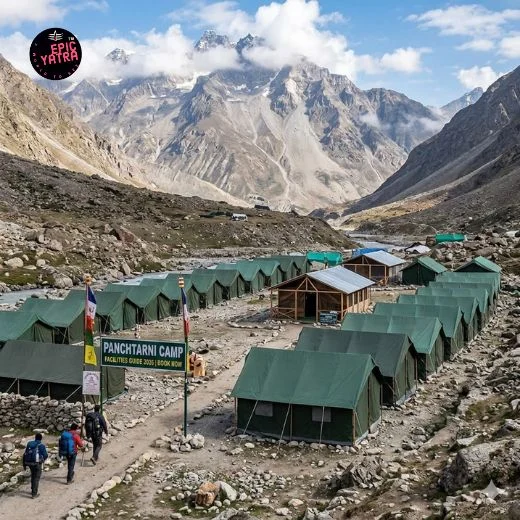
People don’t talk much about Panchtarni like they do about the cave. But ask any pilgrim who has done the Pahalgam route on foot, and they will tell you the night at Panchtarni camp stays with you, the facilities guide. Five rivers are flowing through a wide valley, the smell of langar food is floating through the cold air, and the cave is just 6 kilometers ahead. That is a hard thing to forget.
This guide is not about selling you the romance of it. It is about helping you show up ready — with the right gear, the right expectations about the facilities, and a clear sense of what the camp actually looks and feels like on the ground. Practical information that makes the spiritual part easier to fully experience.
If you are still putting your trip together, exploring well-planned Amarnath pilgrimage tour options early in the year gives you the best chance to secure preferred dates and helicopter slots before demand peaks. But no matter where you stand in your planning journey, make sure you read this before you go.
Panchtarni is the last important camp on Amarnath sacred journey route before the holy cave. It stand at around 3,657 metres above sea level, roughly 6 km short of the shrine. The name itself means 'five rivers' — five glacial streams converge right at this spot, which defines both its beauty and its cold environment.
During the official yatra period declared by the Shri Board (SASB), the camp is managed as a fully serving as a temporary base — tents, langar's, medical posts, army presence, a helipad, and thousands of pilgrims cycling through every single day.
On the Pahalgam route pilgrims are start from the Nunwan base camp and reach Panjtarni after three days of trekking across Chandanwari, Sheshnag, and the Mahagunas Pass. Pilgrims taking the shorter Baltal route also meet at this point, for helicopter travellers, Panjtarni is the drop-off point — meaning that final 6 km walk to the cave is non-negotiable for everyone, however they arrived.
Tents that is what accommodation looks like at Panchtarni, and for most pilgrims that is perfectly fine. You are not here for the room — you are here because the cave is close and your body needs a night's rest before the last stretch.
SASB manages a set of standard tents that sleep four to six people, with blankets provided during peak season. Private operators run additional tent colonies with marginally better insulation and sometimes more space. Neither type has power outlets. Charge everything — phone, power bank, headlamp — before you leave the last town with reliable electricity.
For travelers opting for a helicopter-assisted Amarnath tour, the Panchtarni tent stay is usually included in the itinerary confirm this with your operator before you travel. During the peak weeks, Available tents get booked quickly, and sorting it out on arrival is a stressful experience you can easily avoid.
The Pahalgam route from Nunwan is the longer of the two main paths about 44 km total over four days, but it is gradual altitude the climb is easier on the body than the steep Baltal route. Most medical advisors recommend it for first-timers, older pilgrims, or anyone without significant trekking experience.
Baltal route pilgrims are cover about 14 km in a single long day and also pass through Panchtarni on the way. At peak season the camp sees heavy movement from both directions.
The langar system along the Amarnath route is one of the most touching part of this pilgrimage. At Panchtarni, multiple organization's, Sikh gurudwaras, Hindu trusts, charitable groups is run the free community kitchens. That serve every pilgrim who walks up, without any matter their background or means hot dal, khichdi, sabzi, rice, chai. Often running late into the night during busy periods.
Paid Dhaba's and stalls also sell packaged snacks, dry fruits, glucose biscuits, and instant noodles. They charge higher prices than at the base because supplying goods at this altitude is difficult, so carry small cash with you.
Panchtarni has two main helicopter landing points for the yatra (Neelgrath) near Baltal and Pahalgam. Flights from Pahalgam arrive here, reducing a four-day trek to just a few minutes in the air. For pilgrims who cannot safely walk the entire route, this has opened up the pilgrimage in ways that weren’t possible earlier.
Helicopter seats are limited and its demand is high during the peak time. Pilgrims preparing for an Amarnath journey from Bangalore — or any location at significant distance from the trailhead — should treat helicopter booking as a first priority, not an last-minute thought.
Guide about medical facilities at Panchtarni camp is more substantial than most people expect for a place this remote. SASB operates a fully staffed medical post during the yatra season with doctor, Indian Army and NDRF maintain presence on the route, and helicopter operations is available for serious emergencies.
A pulse oximeter is most useful items you can carry on this trek. Small, cheap, and gives you actual data about how your body is handling the altitude.
The principle here is simple: pack for cold, pack for self-sufficiency, and cut everything else.
Take time to adjust to altitude day before you start the trek and take one day rest in Pahalgam or Srinagar. It is the single most effective thing you can do to reduce your altitude sickness risk before Mahagunas Top.
Start each trekking day early, the mornings are reliably clear in the Himalayas getting your daily distance covered before noon is a habit that pays dividends.
Do not try to compress two stages into one day, altitude does not respect schedules and rushing increases your risk significantly. keep extra time in hand rather than making assumptions everything will go to plan.
Pilgrims booking an Amarnath journey starting from Delhi often find that when permits, transport to Pahalgam, and accommodation are handled together, a lot of the planning pressure disappears.
Ask someone who has trekked in from Nunwan what they remember most, and a fair number will say Panchtarni. Not the cave, not the darshan — Panchtarni. The evening before. The sound of water from five rivers. The langar's glowing in the dark. The tiredness from three hard days of trekking finally eases from your legs.
In the evenings, the camp falls into a calm silence as movement slowly fades. Pilgrims are sitting around the langar fires, strangers are sharing food, the Himalayas surrounding everything. It is not something you plan for — it just happens.
Logistically, Panjtarni is also the nerve center of the upper yatra. Emergency evacuations coordinate from here. Helicopter operations run through here. The SASB and army infrastructure that keeps the pilgrimage functioning at scale is most visible at this point. For trekkers, it is the end of the hardest terrain.
Panchtarni is cold, simple, and unlike anywhere the most most people have ever experienced in a night. The tents are basic but functional, the langar serves hot free meals, and the medical support is surprisingly good. At night, the camp falls quiet and only the streams can be heard, making it feel far from everyday life.
Read the Panchtarni Camp Facilities Guide to know more. Prepare properly, register early, listen to your body on the altitude, and carry what you actually need. The cave will be there when you arrive — just make sure you arrive ready to be present for it. Plan your journey with Epic Yatra for a well-organized package and a smoother, stress-free experience.
Helicopter services to Panjtarni makes the journey is possible for the pilgrims who are not able to complete the full four-day trek, and 6 km walk trek from Panjtarni helipad to the cave. Reasonable walking fitness and a medical clearance from a doctor are required. SASB mandates a medical fitness certificate for all pilgrims regardless of how they travel.
During the peak season (July to August), night time temperatures is often fall a between 2°C and 5°C. And feel even colder after rain or in windy conditions, the blankets provided in SASB tents are sufficient but will not be enough on their own for most people in those conditions.
Weather cancellations are common and not unusual even during peak weeks. SASB-approved operators have rescheduling protocols, but independent travellers may face a longer wait. Carry enough cash and essentials for unexpected situations overnight stay at Pahalgam or Baltal.
Yes — this is the standard plan for most pilgrims. The 6 km each way typically takes 2 to 3 hours per leg. Leaving by 4 to 5 AM is strongly recommended to avoid midday crowds at the cave and afternoon weather on the return. Most pilgrims who start early are back at Panjtarni or descending further before 2 PM.
Mobile ATM units have occasionally been deployed at Panchtarni during peak season but are unreliable. Do not plan your cash around them. Withdraw sufficient cash at Pahalgam or Srinagar before you start. Small denomination notes are far more useful than large ones once you are on the trail.