

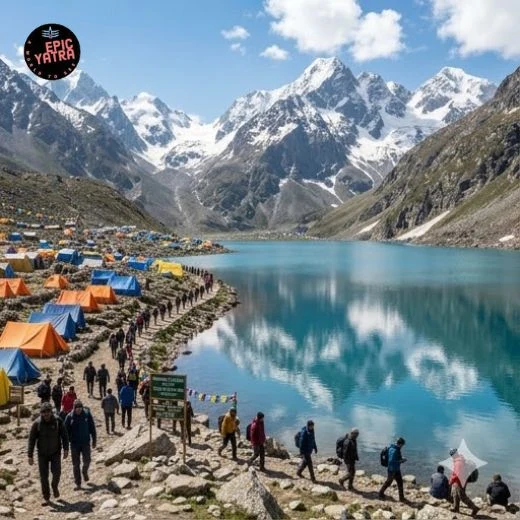
After hours of walking, your legs feel tired, the altitude starts to affect you. Then the trail turns, the valley opens, and suddenly you see it wide stretch of blue-green water lies calmly. Between the mountains, it was waiting to be found and mostly people is just stop and take it in. Sheshnag Lake is at around 3,590 metres in the Anantnag district of Kashmir, and it falls right guide on the Pahalgam route to the Amarnath Cave.
It's an overnight camp stop for the most pilgrims, but it is far more than a rest points. There's history, mythology and kind of calmness here that's hard to find anywhere in another place on the yatra. Planning to visit in 2026? This guide covers all the essential details you should know.
The name itself says a lot, Sheshnag thousand-headed serpent king of Hindu mythology and the one Lord Vishnu is rests upon in the divine ocean. Locals are believed for the generations that guide Sheshnag lake himself lives in these waters. This is not a story only people are tell tourists; it's something the older pilgrims along the path stays with you long after the journey.
The pilgrims are belief is that Lord Shiva is passed through here on his way to the Amarnath Cave, where he revealed the secret of immortality to Mata Parvati. So the lake located inside a spiritual landscape every rock, stream along this route carries some layer of meaning for devout pilgrims.
There's also this thing the lake does with light. Early morning it can look almost grey-blue. By midday it shifts to a deep green. Toward evening, when the sun hits the water at an angle, it goes almost turquoise. The scientific explanation involves glacial particles and refraction. The local explanation is that it's the serpents are flowing below the surface.
It's depending on what you're looking for most Amarnath pilgrimage plans include Sheshnag as the first night camp which means you have the whole evening to spend by the lake before more challenging days begin.
Sheshnag Lake flows into the Lidder River the same river also flows through Pahalgam and gradually meets the Jhelum near Khanabal. This lake is formed from melted ice from the top glacier on the way to Chandanwari, one can find many places with ice over the hilltops.
The Lidder is important beyond just the yatra. It's what keeps the Pahalgam valley green and fertile. Agriculture, orchards, the whole lower valley ecosystem — a lot of it depends on this river system. Standing at Sheshnag and knowing that this still body of water eventually becomes that rushing river down in the valley is one of those quietly satisfying geographical connections.
Trail conditions near the lake shift year to year based on snowmelt. A heavier winter means the path stays icy longer into June. Worth checking conditions closer to your travel dates rather than assuming. Pilgrims can flying into Srinagar can look into an Amarnath pilgrimage plans From Srinagar most operators are handle transfers to both starting points and can help you decide which route is suits your group better.
Distance from Pahalgam to Sheshnag Lake is mainly 22 to 24 kilometer's, its depending on which part of the camp you're counting to and guide. In practice, mostly pilgrims break this by starting from Chandanwari which is about 16 kilometer's from the Pahalgam and is usually covered by local sharing jeep or vehicle and trekking the remaining 12 to 14 kilometer's on foot.
That stretch from Chandanwari to lake is the real work. Pissu Top comes early and it's steep — the kind of climb where you're stopping every hundred metres to catch your breath and pretending you're just "taking in the view." After that the trail evens out, and the descent into the Sheshnag valley is genuinely lovely.
If your travel plan includes the Pahalgam route, Sheshnag is your Day 1 stop. And camps ,tents, langar service, and basic medical support is here. It is organised for to feel the safe but simple enough to feel like you're actually in the mountains.
Far from Sheshnag, you're still mainly 21 to 23 kilometer's from the Amarnath Cave. That's two more days of trekking in normal conditions, Day 2 is takes you over Mahagunas Top at around 4,890 metres (the highest point on this route, and genuinely breathtaking in every sense of that word), down to Panchtarni camp. Day 3 is the final 6-kilometre push to the cave itself.
The Mahagunas crossing is where the altitude really hits people. Some feel fine. Others hit a wall. There's no predicting it — fitness helps, but it's not everything. Slow down, eat something, drink water.
For Some pilgrims who do not trek the whole way, the Amarnath tour plans by helicopter is short the journey experience greatly. You can fly in close to the cave and walk the last short section. It is very different experience from the full trek, but it’s still a valid option especially for older pilgrims or those with health-related concerns.
Complete Pahalgam route to Amarnath and back is mainly 46 to 48 kilometer's in one way. lake is situated at the midpoint, which is exactly why it became the natural first camp.
Pahalgam → Chandanwari: 16 km — usually by local sharing vehicle
Chandanwari → Sheshnag: 12–14 km — Day 1 trek, some difficult with some tough sections
Sheshnag → Panchtarni: 14 km — Day 2, crosses Mahagunas Top
Panchtarni → Amarnath Cave: ~6 km — Day 3 final stretch
Baltal route is the shorter overall but with high climb, and Sheshnag Lake is not on that path at all it's Pahalgam-only. If you're looking at an holy plans via Baltal, you'll skip shesh-nag route entirely.
3,590 metres is not something your body adjusts to automatically. A lot of people underestimate altitude because they feel fine the first few hours. Then they don't.
Travel with a proper operator if it's your first time. South Indian pilgrims especially benefit from organised groups — an Amarnath pilgrimage from Hyderabad with an experienced team means you're not figuring out logistics at 4,000 metres for the first time.
There's guide about Sheshnag Lake that stays with people long after the yatra is over. Pilgrims who've done this route multiple times still talk about it — not the cave, not Panchtarni, but this lake. Maybe it's the exhaustion giving way to something beautiful. Maybe it's the mythology making the landscape feel alive.
Planning for the yatra in 2026, don't treat Shesh-nag as a camp stop. Get there before dark. Walk to the water's edge. Sit for a while. The mountains will still be there in the morning, and so will the trail ahead — but that specific moment at that specific lake is something you don't want to sleep through.
June to August is the window. Book early, with Epic Yatra prepare properly, and take the time to actually be where you are when you get there.
You can travel safely between the June and mid-August when the route is open. Before June, snow still covers significant stretches of the trail. After mid-August, the Yatra typically closes and access becomes restricted.
Yes — it's one of the official Yatra halt camps. Registered tents, langars, and basic amenities are available during the season. If you're thinking of setting up independently outside designated areas, check the current rules first. They change.
The route from Chandanwari to Sheshnag is challenging with some demanding sections Pissu Top is the hard part after that it's more manageable. Most people with decent stamina can handle it, if you have any heart or breathing issues talk to a doctor before taking on to the trek.
Yes, medical posts with first aid, oxygen and basic support are set up along the route during Yatra season. Helicopter emergency services is available, that said carry your own medications.