

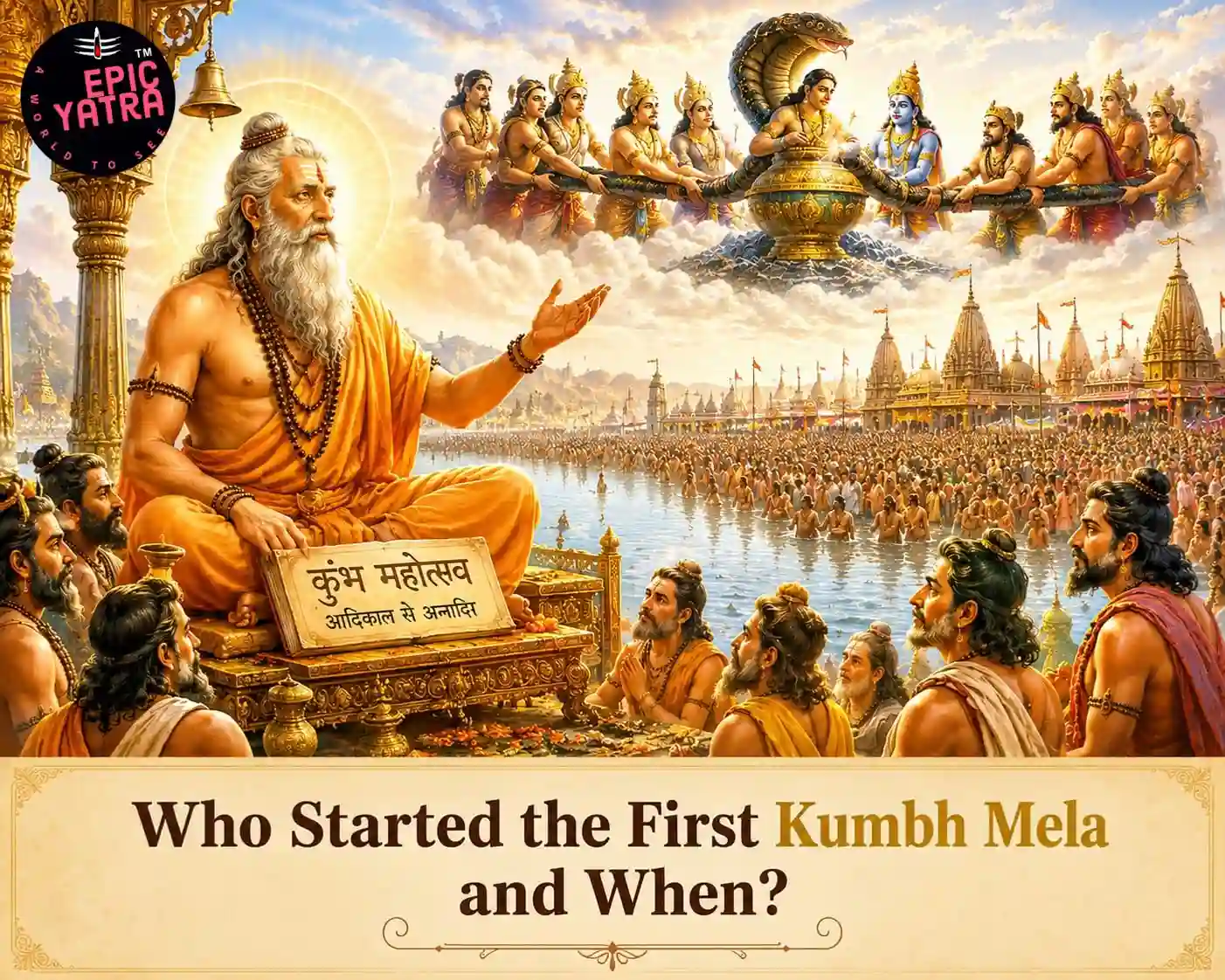
If you've ever seen images of millions of people bathing in a river at the same time—that's the Kumbh. It is one of the largest religious gatherings in the world, where millions of Hindu devotees come together to take a holy bath in sacred rivers. In fact, the history of the first Kumbh Mela is deeply rooted in ancient Hindu traditions and mythology.
Moreover, the festival is celebrate at four holy places in India—Prayagraj, Haridwar, Nashik, and Ujjain—and holds immense spiritual significance for devotees seeking purification and blessings.
People believe that bathing in these sacred rivers during the fair helps wash away sins, brings spiritual blessings, and leads them closer to salvation. Moreover, the festival is also known for its religious ceremonies, prayers, spiritual teachings, gatherings of saints and devotees from across the world, and comfortable Haridwar Kumbh Mela stay options for pilgrims.
In addition, the word "Kumbh" itself comes from Sanskrit, meaning "pot" or "pitcher"—a direct reference to the divine pot of nectar at the heart of its mythological origin story.
It is the most peaceful gathering of people in the world. Moreover, millions of devotees and sadhus (holy men) come together to bathe in a holy river.
There are two reasons people celebrate: a famous story from Hindu mythology and a deep spiritual belief.
According to ancient Hindu stories, a long time ago, the Gods (Devas) and Demons (Asuras) fought a massive war over a special pot called the Kumbh.
Devotees believe that during certain dates when the stars and planets line up perfectly.
It doesn't happen at the same place every time. It rotates between the four cities following a fixed cycle:
The most recent Maha Kumbh was held in Prayagraj in 2025. Therefore, over 400 million people attended, making it the largest gathering of human beings ever recorded anywhere in history.
To understand where the kumbh festival comes from, you need to know the story of the Samudra Manthan—the churning of the cosmic ocean.
The Mela's origins come from an old story about gods and demons fighting over a pot of amrit (the nectar of immortality).
Long ago, gods and demons churned the cosmic ocean together to get this nectar. Moreover, when it finally appeared, a fight broke out because everyone wanted to drink it and become immortal. During this struggle, drops of the nectar spilled at four different places on earth.
To protect the nectar, the god Vishnu took the form of a giant bird and flew away with the pot. The fight between gods and demons continued for twelve days (which is said to equal twelve human years), and during this time, the precious drops fell at those four sacred spots.
Because the nectar touched these places, people believe they became holy. Moreover, the Kumbh is held at these spots in rotation, once every twelve years, to remember this divine event. Therefore, people believe that bathing there during the festival gives the same blessings as the nectar once did—purifying the soul and freeing a person from sins.
This is why millions of people travel to take a holy dip during the Kumbh Mela—it's seen as a chance to connect with that ancient miracle and cleanse themselves spiritually.
The Kumbh Mela is thousands of years old; there isn’t just one single person who started Instead, its history of firsts is a mix of ancient stories, grand kings, and famous saints.
According to Hindu beliefs, the Kumbh Mela started with a story called Samudra Manthan (the churning of the ocean).
Here is how the festival came to be, explained in simple terms:
If we look at actual written history, the first ruler credited with organizing and backing this event on a massive scale was King Harshavardhana in the 7th century.
A famous Chinese traveler named Xuanzang (Hiuen Tsang) visited India back then. Therefore, he wrote down that the king held a massive gathering every five years at Prayag (now Prayagraj). The king was so generous that he would give away all his wealth, clothes, and jewels to the needy families, scholars, and holy men during this festival.
Harshavardhana didn't start the Kumbh Mela from scratch, but his support gave it a grand, royal stage — and Xuanzang's writings gave us our oldest surviving historical record of it.
In the 8th century, a great saint and philosopher named Adi Shankaracharya gave the Kumbh Mela the shape we see today.
He wanted to bring Hindu holy men and regular people together from all over India to talk about spirituality, debate, and unite the community. He encouraged different groups of saints (called Akharas) to gather at the festival, making it a regular, structured event.
In addition, the 13 major Akharas still participating in the Kumbh Mela today trace their lineage directly to Shankaracharya.
To sum it up:The Gods dropped the nectar, King Harshavardhana made it a grand historical event, and Adi Shankaracharya organized it into the spiritual festival we know today.
No one knows the exact day or year the first Kumbh Mela started. Because it is so old, its story is divided: what faith believes and what history can actually prove.
Here is the easiest way to understand when it began:
According to Hindu belief, the tradition began at the moment of Samudra Manthan, when nectar drops fell to Earth
According to Hindu belief, the tradition began at the moment of Samudra Manthan, when nectar drops fell to Earth at the moment of Samudra Manthan, when nectar drops fell to Earth.
Firstly, based on historical records, the earliest gathering linked to the Kumbh Mela took place at Prayagraj, where the Ganga, Yamuna, and the invisible Saraswati rivers converge.
Additionally, people have considered this city sacred for thousands of years. Furthermore, Hindus regard this river confluence as highly holy; therefore, it became an important pilgrimage site.
King Harshavardhana plays an important part in the early history of Kumbh Mela, mainly because of moreover what the traveler Hsuan Tsang witnessed and wrote about during his reign.
In short, Harshavardhana didn't "start" the Kumbh Mela, but his royal patronage and the event Hsuan Tsang witnessed during his rule gave us our earliest historical proof of such a gathering.
Born in 788 CE, Adi Shankaracharya is arguably the most important human figure in the Kumbh Mela's history. Before his time, river gatherings existed but were scattered and uncoordinated. He brought them together.
Here's what he actually did:
His impact was so lasting that the Kumbh Mela we see today—with its grand processions, its Akhara rivalries, and its fixed astrological timing—is essentially the festival he designed over 1,200 years ago.
A lot of people use these terms interchangeably, but they're actually quite different:
Moreover, Kumbh Mela began as a sacred religious gathering and gradually grew into one of the most important festivals in Hinduism.
People consider Kumbh Mela one of the largest and most important Hindu festivals because it carries deep spiritual significance and follows centuries-old traditions.
Kumbh Mela is celebrated at four sacred places in India.
According to Hindu tradition, drops of Amrit (nectar of immortality) fell at these locations during the divine struggle between the gods and demons.
1. Prayagraj (Allahabad), Uttar Pradesh
These four holy places host Kumbh Mela at different times based on special planetary alignments, attracting millions of pilgrims seeking spiritual blessings.
In 2017, UNESCO formally inscribed the Kumbh Mela on its Representative List of Intangible Cultural Heritage of Humanity — a recognition. That places it alongside traditions like yoga, Vedic chanting, and classical Indian dance forms.
UNESCO's recognition highlighted the first Kumbh Mela history as a gathering that cuts across caste, class, and regional identity—a rare example of a living tradition that has survived for over a millennium and continues to grow. Moreover, the inscription also noted the remarkable logistical feat involved in hosting tens of millions of people safely, describing it as a demonstration of collective human organization unlike anything else in the world.
If you're planning to attend the Kumbh Mela, here are the confirmed upcoming events:
Pilgrims planning to attend the sacred bathing dates can book a Nashik Kumbh pilgrimage tour in advance for a well-organized spiritual journey.
Today, Kumbh Mela stands as one of the world’s largest spiritual gatherings and draws millions of devotees, saints, and visitors.
Today, Kumbh Mela continues to be a symbol of faith, devotion, and spiritual unity, bringing people together from across India and the world.
The first Kumbh Mela remains a fascinating part of Indian history and tradition. Here are some interesting facts:
"Kumbh" is Sanskrit for "pot"—a nod to the divine vessel of nectar.
Over time, these religious gatherings have gradually evolved into the modern Kumbh Mela.
Today, people recognize Kumbh Mela as one of the largest religious gatherings in the world, widely celebrated for its scale and devotion. For those planning to attend the upcoming Nashik event, advance Nashik camp stay reservations can help ensure a comfortable and convenient pilgrimage experience.
In fact, it shows how an ancient spiritual tradition grew into a global symbol of faith and devotion.
The history of the first Kumbh Mela is a unique blend of mythology, faith, and records. Moreover, its origin comes from the ancient story of Samudra Manthan and the divine nectar of immortality, and the earliest historical records appear in 644 CE during King Harshavardhana’s reign. Later, Adi Shankaracharya helped organize the festival into the structured spiritual gathering we know today.
In addition, over the centuries, Kumbh Mela has grown from a sacred river gathering into one of the world’s largest religious events. Moreover, today, it is celebrated at Prayagraj, Haridwar, Nashik, and Ujjain. Devotees planning to attend the Haridwar gathering can explore dedicated Haridwar pilgrimage tours for a comfortable and well-organized spiritual journey.
Moreover, it continues to attract millions of devotees seeking spiritual blessings and inner purification. In addition, its UNESCO recognition and record-breaking attendance at the 2025 Maha Kumbh highlight its enduring importance as a symbol of faith, tradition, and cultural unity.
Ans. No single person started it. Ancient mythology gives it its roots, and Adi Shankaracharya organized it into a structured event around the 800s CE.
Ans. There's no exact date. The earliest written record is from 644 CE, documented by the Chinese traveler Hsuan Tsang.
Ans. The first Kumbh Mela traces its roots to Samudra Manthan, with the earliest recorded gathering at Prayagraj in 644 CE.
Ans. The earliest recorded gathering took place at Prayag (modern-day Prayagraj), where rivers meet together.
Ans. Moreover, the people celebrate it to remember the mythological story of nectar spilling at four sacred places and believe bathing there cleans sins and brings spiritual blessings. Therefore, it is highly sacred.
Ans. Firstly, it follows a 12-year cycle, rotating between four holy locations: Prayagraj, Haridwar, Nashik, and Ujjain. Finally, visit holy places in India with Epic Yatra trips.