

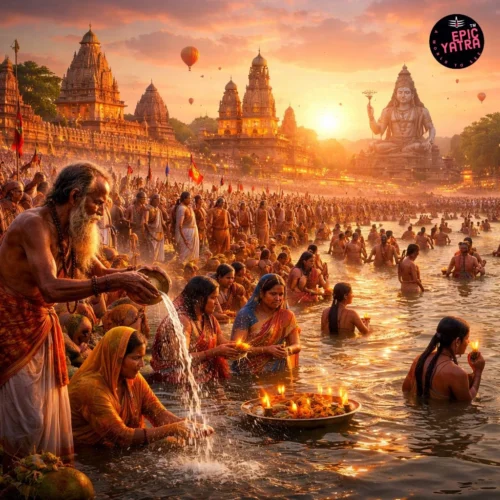
Hindu culture, spirituality, and ancient traditions deeply shape the history and significance of Kumbh Mela. Moreover, it is one of the largest religious gatherings in the world, where millions of devotees come together to take a holy dip in sacred rivers. Furthermore, this grand event takes place in four holy cities—Haridwar, Prayagraj, Ujjain, and Nashik—on a rotational basis.
The origin of the Kumbh Mela comes from a famous Hindu story called the Samudra Manthan (churning of the ocean). According to this legend, gods (Devas) and demons (Asuras) worked together to churn the ocean to obtain Amrit.
During this process, a pot (Kumbh) filled with nectar appeared. Then, gods and demons began a great fight to get the pot. Meanwhile, as the god flew away carrying it, a few drops of nectar fell at four places—Haridwar, Prayagraj, Ujjain, and Nashik.
This is why these four cities became sacred, and people celebrate the Kumbh Mela there. This story clearly explains the origin of Kumbh Mela and shows why people consider it so holy. You can also explore guided pilgrimage tours to experience this divine gathering more comfortably and meaningfully.
The Kumbh Mela's history is not only mythological but also supported by historical records.
As a result, people have celebrated Kumbh Mela for thousands of years, making it one of the oldest continuing traditions in the world.
The significance of Kumbh Mela in Hindu tradition lies in its spiritual power. It is believed that during this time, the rivers become extra sacred due to specific planetary positions.
Devotees believe that:
Moreover, the gathering of saints, teachers, and devotees creates a deeply spiritual atmosphere, thereby strengthening faith and devotion, while well-planned pilgrimage stays and guided spiritual tours make the entire experience more comfortable and meaningful for visitors.
The most important ritual at Kumbh Mela is taking a dip in holy rivers like the Ganga River, the Yamuna River, and the Godavari River.
Groups of saints known as 'akharas' play a major role:
In addition, well-planned stay arrangements in Haridwar help pilgrims remain close to these spiritual gatherings and experience the guidance of saints more comfortably.
The importance of Kumbh Mela in India goes beyond religion. It is also a cultural festival that showcases unity in diversity. People from different regions, languages, and backgrounds come together, creating a unique atmosphere of harmony.
Visitors can experience the following:
Moreover, Kumbh Mela reflects India’s rich heritage and promotes cultural exchange.
There are different types of Kumbh Melas celebrated based on time and scale:
1. Maha Kumbh Mela – Happens once every 144 years in Prayagraj
2. Purna Kumbh Mela – Held every 12 years at each location
3. Ardh Kumbh Mela – Occurs every 6 years in Haridwar and Prayagraj
Each type holds equal spiritual importance but varies in scale and frequency, and many travellers also explore similar pilgrimage experiences in other sacred destinations like Nashik through thoughtfully planned spiritual tours.
Have you ever wondered why Kumbh Mela is celebrated and why millions attend?
Here are simple reasons:
Emotionally, devotees feel peace, joy, and a sense of belonging when they participate in this sacred gathering, especially when they opt for well-organised spiritual tours with comfortable tent stays in Nashik.
The History and Significance of Kumbh Mela beautifully combines mythology, history, spirituality, and culture. Over time, it has evolved from the story of Samudra Manthan into a grand gathering, thereby continuing to inspire millions.
Moreover, it is not just a festival; rather, it is a powerful spiritual journey that connects people to their faith, traditions, and inner peace.
A. The origin of Kumbh Mela is linked to the story of Samudra Manthan; as a result, drops of nectar fell at four sacred locations.
A. It is believed to cleanse sins, thereby promoting spiritual growth and ultimately helping achieve moksha.
A. The holy dip not only purifies the soul but also helps remove negative karma.
A. It is held every 12 years at each location; meanwhile, Ardh and Maha Kumbh occur at specific intervals.
A. Moreover, the Kumbh Mela is hosted in Haridwar, Prayagraj, Ujjain, and Nashik. Unlock amazing adventures with Epic Yatra.