

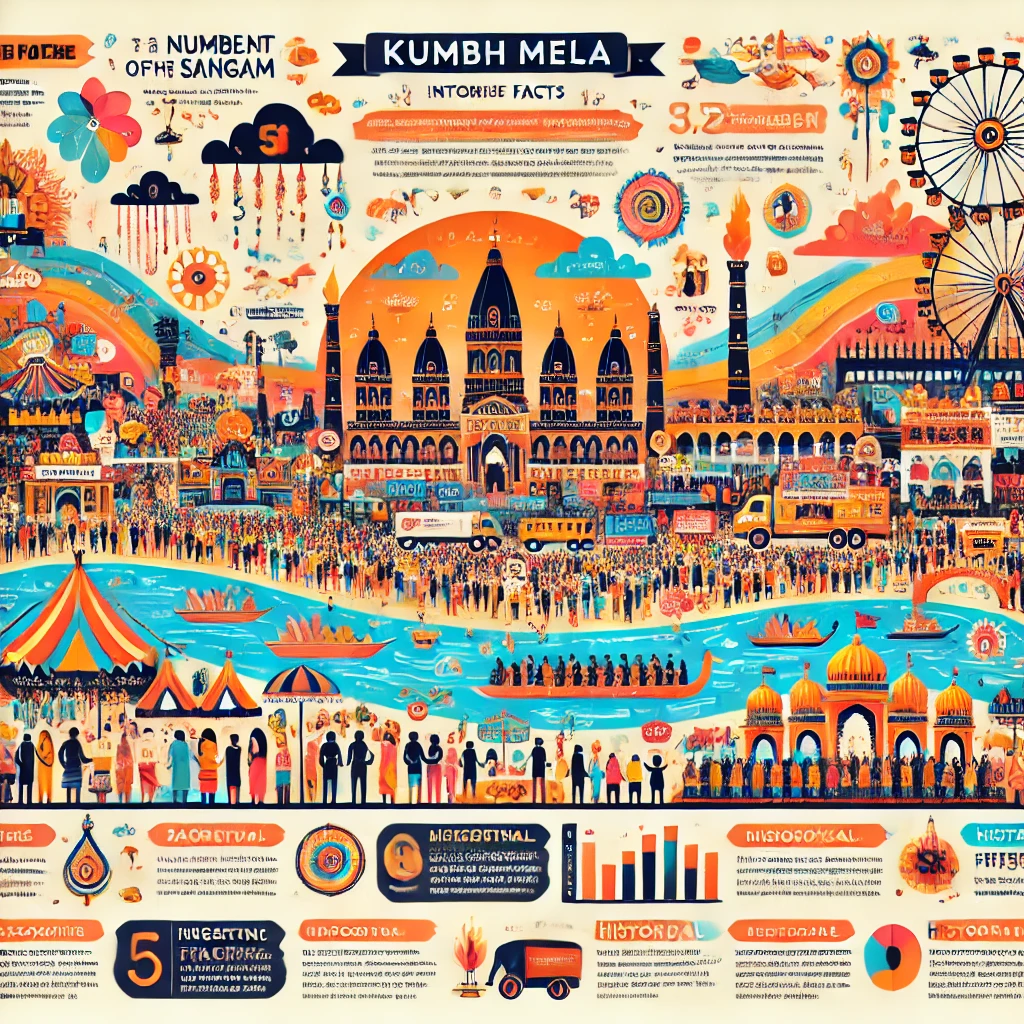
Welcome to our new post, Interesting Facts About Kumbh Mela. The 2025 Prayagraj Kumbh Mela—also called Triveni Sangam—is more than a religious congregation. In fact, it’s a festival of spirituality, history, and unity like no other in the world. Specifically, the festival takes place on the banks where the Ganges, Yamuna, and the mythical Saraswati rivers meet in Uttar Pradesh. Moreover, millions of people from across the globe attend this UNESCO World Heritage-recognised event. Indeed, it boasts of ancient rites, diverse cultures, and mammoth logistics.
Consequently, the Kumbh Mela Package is the mother of all adventures. Ahead of the impending Kumbh Mela Tour Package, I have compiled an amazing collection of 10 fascinating facts that make Prayagraj Kumbh Mela 2025 a unique event, ready for people from all corners of the world to experience.
You can best understand the roots of the Prayagraj Kumbh Mela Package through Hindu beliefs, particularly the cosmic incident of the Samudra Manthan, during which four drops of the nectar of immortality (Amrit) fell at four places on Earth—one of them being Prayagraj. The festival celebrates the victory of good over evil and intellectual enlightenment, guiding participants on a journey toward spiritual awakening. Interesting Facts About Kumbh Mela further reveal the depth and significance of this extraordinary gathering.
During the Kumbh Mela, Hindus bathe in the river’s confluence, or Sangam, washing away their sins and attaining Moksha, or salvation from the cycle of life and death.
It is due to the historical and cultural significance of the gathering that it has survived for thousands of years, along with each Kumbh Mela package renewing the enthusiasm and devotion in the common people.
What strikes us as one of the unique features of the Nashik Kumbh Mela Packages is its 12-year circle of life. The festival takes place every third year at one of the four places: Prayagraj, Haridwar Kumbh Mela Package, Ujjain, and Nashik. Notably, Prayagraj hosts the largest, the Maha Kumbh, every 12 years, while it holds a smaller Ardh (half) Kumbh every six years. Furthermore, this twelve-year cycle follows the calculated positions of the planets Jupiter and the Sun, providing an astronomical counterpoint to the festival itself.
Archives People typically call the Prayagraj Kumbh Mela the largest gathering of humanity on the planet. At previous Maha Kumbh Melas in Prayagraj. As many as 10.0 million attend the festival on a peak day, and upward of 120 million attend during the entire festival. There can be an impressive attendee count and energy that is choreographed by a sensitive ballet of volunteers, staff, and resources. All working to make it seamless for everyone. The sheer magnitude and logistics of this event have brought international acclaim and proved India has the capacity to accommodate unimagined numbers.
Among Kumbh Mela Accommoation, Shahi Snan, or Royal Bath, is a key highlight. Observed on special dates calculated through astrology. The Shahi Snan is a succession of ritual baths that are led by different groups of sadhus, saints, and seers belonging to different Akharas (spiritual organisations) on the assigned dates. The royal baths are led by the Naga sadhus. Who go naked with ash smeared on their bodies. The devotees consider the river to be a divine source where one can wash away one’s sins and free one’s soul. The pilgrims and the visiting people are thrilled seeing the processions with resplendent banners portraying gods. The sound of spiritual chants and their traditional dresses are the unique sights.
The logistics planning for the Prayagraj Kumbh Mela Package 2025 is on the scale of gargantuan. Turning these immense riverbanks into a makeshift city, officials create roads, bridges, toilets, hospitals, security sentries, and housing tents to meet the needs of millions. Organisers plan the festivals in great detail so that water, food, doctors, and sanitation are available for everybody. Key to synchronising these efforts is the use of state-of-the-art technology. They’ve armed themselves with surveillance drones, AI crowd control systems, and digital maps. All of which are fused together to keep the peace and cope with the vast crowds. The authorities also follow eco-friendly measures during the meeting in order to alleviate the environmental consequences of the congregation, thus striking a balance between spirituality and sustainability.
The AKHARAS, religious Hindu orders, host the gathering. Today’s prominent Akharas—Juna, Niranjani, Mahanirvani, Atal Akhara, and many others—follow distinct theologies and consist of Naga sannyasis, Urdhwavahurs (who perform severe austerities), Parivrajakas (wandering monks), and others. The Akharas are instrumental in the preservation of the religious aliveness of the Kumbh Mela accommodation. They hold lectures, debates, and ceremonies. Creating a sense of community despite their divergent philosophies. To see these Akharas converge is like seeing the illustrative tradition of long-ago times. When twelve ascetic orders came with their own traditions and rituals at the grand congregation.
The most interesting and eye-catching part of any of the Nashik Kumbh Mela packages is, without a doubt, the Naga sadhus. Famed for their dreadlocks and dust-covered bodies, these naked renunciants, in fact, devote themselves to extreme forms of meditation and asceticism. Consequently, their visit to Kumbh Mela brings an air of mystery and reverence to the festival. Moreover, Naga sadhus forsake all earthly possessions on their quest to reach Nirvana and are, therefore, seen as the protectors of the Hindu faith. Furthermore, many travellers and photographers visit the Kumbh Mela to catch a glimpse of these sadhus, who, in essence, represent a life that folks both admire and misunderstand.
Besides its religious importance, the Prayagraj Kumbh Mela Tent Booking is also a cultural spectacle. Folk artists sing and dance or perform classical music and drama, which all adds to the overall colour of the fair. Cultural pavilions display Indian culture, art, handicrafts, and literary works, providing a complete look at the culture of the country’s ancient traditions and modern aspects. This mix of spirituality and tradition is why the Kumbh Mela draws people who are not Hindu. It often draws international visitors not only to witness its religious practices but also to experience India’s rich, diverse cultural tapestry.
The Kumbh Mela Camp Booking is a boon for the local economy. Creating job opportunities and promoting tourism in Prayagraj and in the periphery. The event attracts tourists, pilgrims, and religious leaders, leading to increased demand for lodging, food, and modes of transportation. 1 Lull Clocks Local craftsmen also do a thriving business in hawking their handicrafts, souvenirs, and local cuisine. This too adds to the economic prosperity of the region. There has been a surge of international interest and investments in the region. Resulting in improved infrastructural facilities and closer linkages to international tourism markets. And transforming the Kumbh Mela into a key event for economic as well as cultural development.
The Nashik Kumbh Mela Camp Booking is likely to be more tech-savvy than ever before. From crowd management through AI to digital darshan (ceremony viewing), technology is transforming how the event is planned and experienced. Smartphone apps, Google Maps for navigation, and easy access to information are enhancing convenience, while livestreaming select events allows people both on-site and at a distance to participate. Advances in digital security, payment systems, and crowd analytics are creating a more seamless experience. Showing how old-world festivals adapt in the digital era. Interesting Facts About Kumbh Mela further highlight the festival’s unique blend of tradition and modern innovation.
The upcoming Prayagraj Kumbh Mela 2025 is set to be a unique union of history and modernity. While exploring its different aspects. We not only understand the enormity and importance of the Kumbh Mela. But also acknowledge its influence in shaping India’s spiritual and cultural identity. Whether you are drawn to the ritual baths, age-old traditions, or the spectacle of human unity. There’s the Kumbh Mela Accommodation to enhance your experience. Interesting Facts About Kumbh Mela reveal that this festival is as spiritually transformational as it is culturally illuminating.
Symbolically, the Kumbh Mela encourages devotees to renew themselves and liberate themselves from a materialistic life, primarily through the legend of Samudra Manthan. The people feel that taking a bath at Sangam during the Kumbh absolves them of their sins and fast-tracks their journey towards moksha.
after every 12 years?
Naga sadhus are ascetics who detach themselves from the worldly ties and perform severe penances. They represent to the Hindu the more abstruse principles of his faith.
The event draws tens of millions of visitors. In past years attendance has been more than 120 million over the entire festival.
Akharas are orders of monks associated with various Hindu sects. They have a major role in religious rituals and form an important part of the structure of the Kumbh Mela.
The emphasis is on going green, from waste management to solar lighting to advocating the use of biodegradable material.