

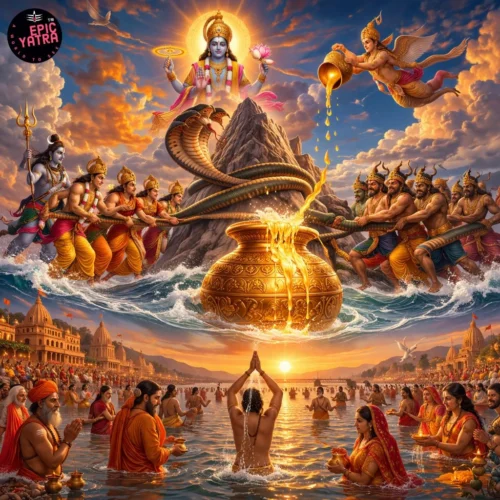
India is full of colourful festivals. However, one is huge and exceptional—the grand festival. The origin of the Kumbh Mela lies in an ancient myth that draws millions to gather peacefully. In fact, it is the largest peaceful gathering in the world, where many people come to one place and believe in the same thing.
Moreover, people travel from different countries, cultures, and backgrounds. Nevertheless, they all engage in a simple act—immersing themselves in sacred rivers. But have you ever wondered why?
To explain, we need to go back thousands of years. Ultimately, the answer lies in an ancient myth that still shapes this grand event today. This timeless story forms the foundation of the festivities and rituals that continue to draw millions of pilgrims from across the world.
The word “Kumbh” means "a pot", and “Mela” means "gathering". Therefore, together, it refers to a sacred gathering connected to a divine pot of nectar."
In addition, in Hindu culture, this event is not just a festival. It is a time of strong belief. For instance, people think bathing now makes you feel clean inside and calm.
As a result, millions attend. Simply put, people come looking for hope, healing, and a fresh start. Some attend for devotion, while others come to experience something truly powerful and unique. Explore the celebration with a travel package for the Kumbh Mela.
A Mythological Story
Long ago, gods and demons worked together to mix the ocean in Samudra Manthan because they wanted a magic drink called amrita, which could help them live forever.
To do this, they used a big mountain like a stick and a giant snake like a rope. As a result, many things came out of the ocean, both good and dangerous. This is why the story behind the origin of the Kumbh Mela begins here.
Finally, a pot of amrita appeared, marking the true beginning of the story.
Why Gods and Demons Fought for Amrita
Once the nectar appeared, both sides wanted it. After all, who wouldn’t want to live forever?
A chase began. The gods tried to protect the nectar, while the demons tried to take it. This chase lasted for days across the sky.
The Dropped Nectar and Four Sacred Places
During this chase, a few drops of the nectar fell on Earth. These drops landed in four places—Prayagraj, Haridwar, Ujjain, and Nashik.
Because of this, these places became sacred. Even now, people believe the rivers carry special energy. Therefore, the gathering takes place at these four locations.
Locations
Each of the four cities has its importance:
Why These Four Cities Matter
These places are not random. They are deeply connected to the story of nectar drops.
Furthermore, the timing of the event depends on the position of stars and planets. When the alignment is right, the festival takes place in one of these cities.
Historical Records
Evolution Over Time
Sacred Ritual of the Bath (Snan)
Peshwai Procession
Aarti Ceremony
Yajnas (Fire Rituals)
Deep Daan
Spiritual Practices
Best Time to Visit
Major Snow Dates
How to Reach
Planning early helps avoid last-minute issues.
Guide to Booking Your Stay
Staying near the event is important; furthermore, many organised camps offer tents with basic and luxury amenities.
👉 You can, furthermore, explore well-planned tent stays near the river area, ultimately providing a comfortable experience.
👉 If you're planning your visit, consider comfortable stay options in sacred cities to make your journey smooth.
What to Expect
Expect crowds, colours, and constant activity. Moreover, you will see people praying, walking, chanting, and celebrating.
Crowd Management
Rush-Related Risks
Public service camps
As a result, the event boosts tourism and supports local businesses. Consequently, shops, hotels, and transport services all benefit.
It also helps preserve traditions and culture. People from different regions come together and share their beliefs.
Modern technology plays a big role now.
These tools help manage the event smoothly.
Even in today’s rapidly changing world, people naturally seek peace. Similarly, this gathering provides that calm. Moreover, in addition to this, it connects people to their roots. Ultimately, as a result, it reminds them to slow down and reflect.
Furthermore, it attracts global attention. Visitors from around the world come to witness this unique experience.
The grand festival is, indeed, a story, a belief, and a journey. Specifically, from the ancient tale of nectar to the modern-day gathering, the origin of Kumbh Mela, consequently, keeps inspiring millions. Furthermore, it shows us how to let go, then start fresh, and finally, ultimately, find peace within.
Whether you visit or simply read about it, the message is clear—every moment is a chance to begin again. Discover this spiritual experience with a Haridwar spiritual journey package.
A. This story, in fact, originates from the myth of ocean churning; consequently, the nectar of eternal life emerged.
A. This happens because the planetary positions follow a repeating cycle.
A. Typically, Prayagraj hosts the largest gathering.
A. Indeed, with proper planning and necessary precautions, it is safe.
A. First, book in advance. Next, pick a suitable place to stay. Finally, follow simple travel advice. Experience journeys beyond the ordinary with Epic Yatra.