

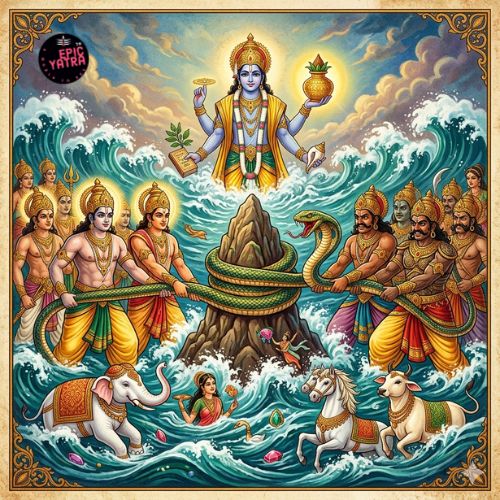
Have you ever wondered why millions of devotees gather at the Kumbh Mela to take a holy dip in sacred rivers? The answer lies in the Samudra Manthan Story Origin, one of the most fascinating tales in Hindu mythology. It tells the story of the great churning of the cosmic ocean and the emergence of Amrit, the nectar of immortality.
This ancient tale is not only filled with adventure, divine powers, and heavenly treasures but also explains the origin of Amrit Kumbh, the sacred nectar of immortality. Even today, the story continues to inspire millions of pilgrims who travel to Kumbh Mela seeking spiritual blessings and inner transformation.
Long ago, the gods and demons were constantly engaged in battles for power. After losing their strength due to a curse, the gods became weak and feared defeat. Seeking help, they approached Lord Vishnu. He advised them to churn the Kshira Sagara, the Ocean of Milk, to obtain amrit—the nectar that could restore their power and grant immortality.
However, the task was impossible for the gods alone. Therefore, they formed a temporary alliance with the demons and began preparing for the greatest cosmic event ever witnessed.
Mount Mandara was used as the churning stick, and the serpent Vasuki was used as the rope. The gods pulled from one side, and the demons pulled from the other. As the churning began, the ocean shook, the heavens trembled, and countless wonders emerged from the depths.
Among the treasures that appeared were the following:
But before the nectar appeared, a deadly poison called Halahala emerged from the ocean.
The poison was so powerful that it put in danger to destroy all creation. To protect the universe, Lord Shiva consumed the poison and held it in his throat. As a result, his throat turned blue, and he became known as Neelkanth.
This heroic act remains one of the most revered moments in Hindu mythology and symbolises sacrifice for the welfare of the world.
After the poison was neutralised, the churning continued. Finally, Lord Dhanvantari emerged from the ocean carrying a golden pot filled with Amrit—the nectar of immortality. The moment the demons saw the pot, they attempted to capture it. A great battle started between the gods and demons. This battle continued across the heavens for several days.
According to tradition, during the chase, drops of Amrit fell at four sacred locations on Earth:
These places later became the hosts of the world's largest spiritual gathering—the Kumbh Mela.
Many people believe that the blessings of Amrit still remain at these holy places. Therefore, taking a holy dip during Kumbh Mela is considered very sacred and auspicious. Those planning to attend can explore guided pilgrimage experiences to make their spiritual journey more comfortable and meaningful.
Millions of devotees travel from across India and around the world to participate in this extraordinary event.
The story of Samudra Manthan is more than mythology.
It teaches valuable life lessons:
Today, pilgrims visiting Haridwar during Kumbh Mela often seek a deeper connection with this sacred story. Many travellers prefer guided pilgrimage experiences that include transportation, spiritual activities, and comfortable stay arrangements near important ghats.
Others choose riverside lodging options that allow them to participate in religious ceremonies while remaining close to the main event areas. During major bathing dates, temporary spiritual villages, luxury tents, and organised camp stays are established to accommodate the massive influx of visitors.
Because millions attend the festival, advance reservations for pilgrimage stays and festival lodging are highly recommended.
The holy dip during Kumbh Mela symbolises much more than a physical bath.
It represents:
For many devotees, participating in Kumbh Mela is a once-in-a-lifetime experience that strengthens their spiritual journey.
Thousands of years have passed since the story of Samudra Manthan was first told. However, its message remains timeless. Moreover, the struggle between good and evil, the rewards of perseverance, the value of cooperation, and the pursuit of spiritual growth continue to inspire people of all ages. As a result, every Kumbh Mela serves as a living reminder of this extraordinary event.
As devotees gather at the sacred rivers, they are not merely attending a festival—they are becoming part of a story that began in the cosmic ocean itself.
The story of Samudra Manthan and the origin of Amrit Kumbh is one of the most powerful narratives in Hindu mythology. It explains not only the emergence of the nectar of immortality but also the spiritual roots of Kumbh Mela.
Moreover, from the heroic sacrifice of Lord Shiva to the divine battle for Amrit, every chapter of this story offers valuable lessons about life, faith, determination, and spiritual awakening. As a result, it continues to inspire millions of people even today.
Even today, millions of devotees gather at Kumbh Mela to honour this sacred legacy. As a result, this ancient tradition continues to connect the present generation with one of the greatest stories in Hindu mythology.
A. Samudra Manthan is the ancient Hindu story of the churning of the Ocean of Milk by gods and demons to obtain amrit, the nectar of immortality.
A. Amrit Kumbh refers to the sacred pot containing the nectar of immortality that emerged during Samudra Manthan.
A. Kumbh Mela is linked to the belief that drops of Amrit fell at Haridwar, Prayagraj, Nashik, and Ujjain during the celestial struggle for the nectar.
A. Lord Shiva consumed the deadly Halahala poison to protect the universe from destruction.
A. The holy dip symbolises purification, spiritual renewal, and the cleansing of negative influences. Explore India's holy destinations and enjoy unforgettable spiritual experiences with Epic Yatra.