

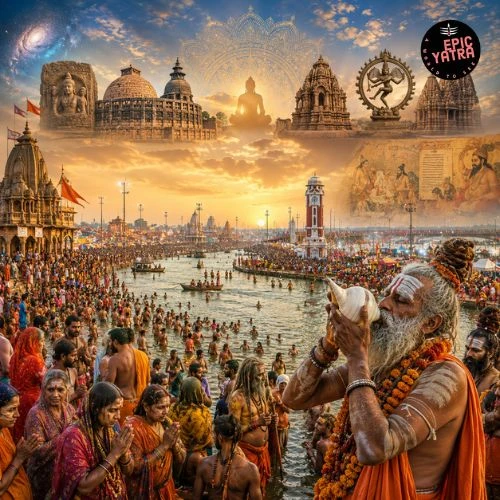
The Kumbh Mela is the world’s largest religious festival. Millions of devotees, saints, pilgrims, and travellers gather on the banks of holy rivers to take ritual baths for purification, offer prayers, join spiritual discussions, and take part in religious rituals. This UNESCO-recognised Kumbh Mela is celebrated in the most important sacred cities of Hindu tradition in India – Prayagraj, Haridwar, Ujjain, and Nashik.
Kumbh Mela hardly connected with trust, love, pure bathing, and cultural groups. Devotees believe that baths in pure rivers during this time cleanse their crimes and lead them toward spiritual freedom. The festival also includes India’s religious rituals, old traditions, spiritual teachings, yoga practices, devotional music, and rich cultural history.
Today, many travellers choose comfortable pilgrimage stays and guided religious journeys like Epic Yatra to enjoy a well-organised spiritual travel experience. As a result, they can experience the grandeur of the festival in a more comfortable and organised way.
UNESCO is a specialised agency of the United Nations working for the preservation of culture, education, science and heritage worldwide. The organisation identifies important traditions, monuments, festivals and cultural practices that are significant to man.
UNESCO protects two major forms of heritage:
The intangible cultural heritage of the organisation is the traditions transferred from generation to generation by the societies. Traditions are signs of identity, traditions and shared human values.
UNESCO has listed the Kumbh Mela on the World Heritage List for its outstanding cultural, spiritual and social value. The festival has been listed as UNESCO Intangible Cultural Heritage for uniting millions of people in peace and for the preservation of ancient traditions that still live on in modern society.
The Kumbh Mela is much more than a religious festival. A tradition of culture that is handed down through the ages. A festival is a mix of holy rituals, stories, spiritual teaching, devotional singing, traditional knowledge systems and social unity.
Also, the festival was UNESCO-certified as inclusive and non-discriminatory to people from all walks of life. They are yatris together on the same spiritual journey, from different regions and tongues , from different societies and economic levels.
The great assembly is evidence of India’s rich spiritual culture and the relevance of ancient traditions in modern times.
Kumbh Mela has many ancient cultural traditions that are centuries old. Saints and spiritual leaders are now exposing visitors to Vedic teachings, philosophical discussions, yoga, meditation and devotional music.
The main attraction of the festival is the traditional procession called ‘Shahi Snan’. On the great festivals the saints and akharas proceed to the holy river with chants and music and flags and spiritual rejoicing.
The assembly also anticipates the next types of ancient art:
The festival is also a platform for local craftsmen, artisans, food vendors and cultural performers that add to the spiritual feel of the event.
Spiritual Tours – Those looking for spiritual tours can find well-organised pilgrimage tours with stays at the riverside and premium spiritual camps for those travelling to Nashik and Haridwar for sacred travel arrangements.
One of the largest reasons for Kumbh Mela to get recognition from UNESCO is the message of unity and peace that it sends out. In peace, lakhs of people come together in spite of the differences of language, caste, region and social status.
For it is a feast of shared souls. “Pilgrims are of one faith and of one devotion. In the groups, people together eat, pray and do rituals.
Kumbh Mela attracts people from many countries. Sacred travellers, experts, photographers, and culture lovers come to observe the festival. The big gathering has made Kumbh Mela a symbol of peace, unity, and spiritual travel.
As the number of visitors is increasing, many travellers are looking for comfortable pilgrim stays, spiritual riverside camps and organised devotional tours to enjoy the event seamlessly during the major bathing dates.
UNESCO’s List of Intangible Cultural Heritage is a list of customs and traditions that have been recognised as being important to the diversity of cultural heritage around the world and protected.
It is made up of traditions and practices that communities recognise as their living heritage. Intangible heritage is not buildings or monuments. It is about the knowledge and the practices which are passed down from one generation to the next.
The list includes:
Apart from Kumbh Mela, UNESCO now wants to preserve for posterity the spiritual traditions of India.
The award also helps to raise awareness of India’s rich cultural heritage around the world and encourages governments and organisations to protect such traditions through improved management, education and cultural preservation programmes.
The saints and akharas are the source of the spiritual identity of the Kumbh Mela. Akharas are spiritual institutions led by saints and spiritual leaders that maintain ancient Hindu traditions and teachings.
During Kumbh Mela, Akharas organise the following:
The festival is a window to the world of the Naga Sadhus and also their special spiritual practices. Participation means sacrifice, commitment, and spiritual discipline.
These saints are very much involved in passing on the traditional knowledge to the younger generation and preserving the spiritual heritage of India.
The pilgrims attending these holy crowds generally look for comfortable temporary spiritual accommodation in the vicinity of the bathing ghats in order to stay close to the important rituals and processions during the event.
The Kumbh Mela is recognised by UNESCO and is becoming popular globally. As a result, its status has promoted religious tourism and has brought in more tourists from other countries to see the beauty of the festival. Furthermore, governments and tourism agencies built facilities, transport, sanitation, safety systems, and accommodation facilities to cater for the increasing numbers of visitors.
The main events of the Kumbh Mela today are:
Festivals are a busy time of the year, and therefore many travellers are now pre-booking premium religious stays and guided spiritual tours for a more seamless pilgrimage experience. Moreover, organised travel packages are the new comfort and security for foreign tourists and families on spiritual tours to Haridwar and Nashik. Furthermore, these packages help pilgrims enjoy a stress-free and well-managed journey.
India continues to preserve the heritage of Kumbh Mela through large-scale planning, cultural promotion, and public services development.
Authorities work together to manage:
Age-old rituals, traditions and teachings connected to the festival are also preserved by cultural bodies and spiritual institutions.
Digital technology has proved to be a major tool for the management and conservation of Kumbh Mela. Visitors can navigate the festival with online information systems, real-time updates, digital maps and advance reservations. Moreover, these technologies improve crowd management and safety. In addition, they help pilgrims access important services more easily. As a result, the overall experience of the Kumbh Mela becomes more organised and convenient.
Moreover, these digital services improve safety and convenience for pilgrims. In addition, they help authorities manage crowds more effectively. As a result, the overall experience of Kumbh Mela becomes smoother and more organised.
The organised spiritual camps and stay facilities on the riverside have improved the experience of the pilgrims, especially those coming with families and older persons for the congregation.
The future of Kumbha Mela is very important for world spiritual culture. Even in today’s fast-changing world, the festival still represents trust, simplicity, spirituality, and unity among people.
With its UNESCO status, the Kumbh Mela has become a global cultural icon, linking ancient traditions to new audiences. Moreover today it attracts pilgrims, researchers, filmmakers, photographers, spiritual seekers and international visitors eager to soak up India’s cultural heritage. In addition, the festival highlights India’s timeless spiritual values on the world stage. As a result, global interest in the Kumbh Mela continues to grow every year.
The spiritual tourism market is also calling for organised pilgrimage tours, luxury riverside accommodation, temporary tented villages, and spiritual travel packages.
The festival will also be seen around the world and will guarantee that future generations will continue to learn about India’s rich spiritual traditions and cultural diversity.
The Kumbh Mela is more than a religious gathering.It is a living symbol of spirituality, oneness, devotion and cultural continuity. Moreover, the UNESCO-Recognised Kumbh Mela has gained worldwide respect for preserving age-old traditions and bringing millions of people together in peace and harmony.
The festival is a celebration of the survival of India’s age-old spiritual wisdom and cultural traditions through the centuries. Moreover, the Kumbh Mela is gaining more and more international recognition, and better arrangements are being made for the yatra, which is an inspiration for people all over the world. Therefore, it continues to attract millions of devotees and visitors every year.
The Kumbh Mela is among the very living examples of living heritage of persons for spiritual purification, cultural exploration or devotional travel experiences.
A. UNESCO recognised Kumbh Mela because of its cultural, spiritual, and social importance as one of the world’s largest peaceful religious gatherings.
A. No, Kumbh Mela is included in UNESCO’s Intangible Cultural Heritage List, not the World Heritage Sites list.
A. The festival rotates between Prayagraj, Haridwar, Ujjain, and Nashik.
A. Its cultural significance is spiritual teachings, devotional traditions, ancient rituals, peaceful mass participation and social harmony.
A. UNESCO recognition increased global awareness and boosted spiritual tourism and infrastructure development and also organised pilgrimage facilities.
Experience Sacred Travel with Epic Yatra.