

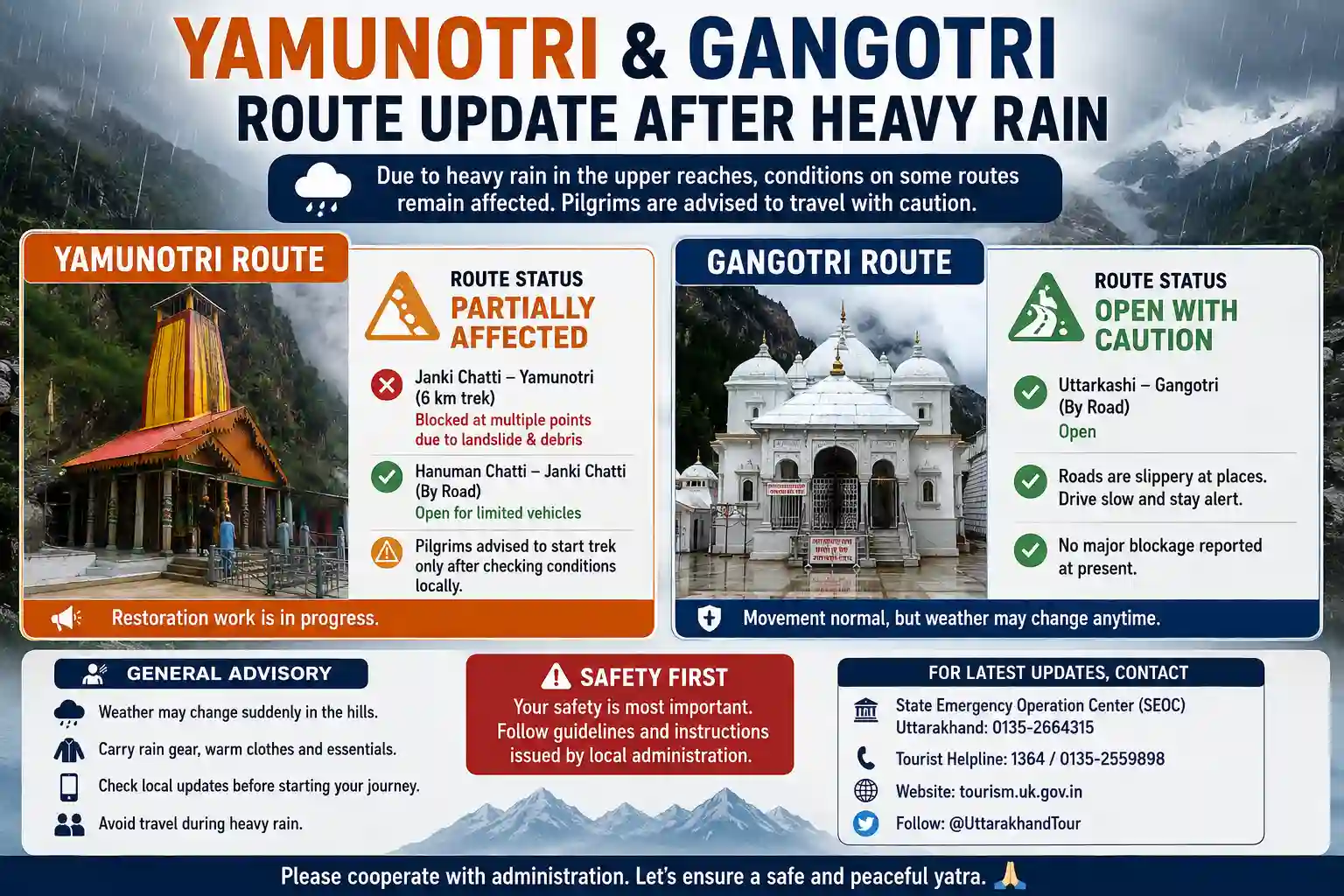
Welcome to the Yamunotri & Gangotri Route Update Blog. The monsoon season has brought fresh challenges to Uttarakhand's mountain roads, particularly around Uttarkashi district, where the routes to Yamunotri and Gangotri have experienced rainfall-related disruptions.
For pilgrims planning the Char Dham Yatra, understanding the latest road situation is extremely important. Heavy rainfall can quickly trigger landslides, falling rocks, debris accumulation, waterlogging and temporary road closures in the Himalayan region.
Recent reports from early August indicate that rainfall has affected both the Gangotri National Highway and Yamunotri National Highway at several locations. In addition, continuous rain and rockfall have caused temporary obstructions on important stretches.
Therefore, pilgrims should not assume that a road will remain open throughout the day simply because it was open earlier. Instead, road conditions should be checked immediately before starting the journey.
The Uttarkashi District Administration also maintains dedicated Char Dham Yatra information, including route maps, control-room information, health advisories and other pilgrimage-related resources.
The latest reports indicate that heavy monsoon rainfall has caused road disruptions in the Uttarkashi region.
According to reports published in early August, debris from rainfall blocked portions of the Gangotri National Highway, including sensitive stretches around Helgugad and other locations. At the same time, the Yamunotri route has also experienced landslide-related disruptions and road instability.
Furthermore, a report dated August 6, 2026, reported that the Gangotri National Highway was closed near Dharasu–Nalupani because of rain-related disruption.
This does not necessarily mean that the entire Yamunotri or Gangotri route remains permanently closed. Mountain-road closures can be highly localised and temporary. Once debris is removed and authorities consider the road safe, traffic can resume.
However, because rainfall can continue to trigger fresh landslides, pilgrims should treat the route as weather-sensitive during the monsoon.
The Yamunotri route is particularly important for pilgrims travelling towards Barkot, Janki Chatti and Yamunotri Dham.
The road journey generally takes pilgrims towards Janki Chatti, from where they continue towards Yamunotri. The final approach to the temple involves a mountain trek.
According to the Uttarkashi district administration, Yamunotri is located at an altitude of approximately 3,293 metres, while the shrine is connected through the Yamunotri road network.
During heavy rainfall, pilgrims may face several problems on this route, including:
Recent reports have highlighted continued landslide activity affecting the Yamunotri Highway following rainfall in Uttarkashi.
Therefore, pilgrims travelling towards Yamunotri should allow additional travel time.
Moreover, the final trek should not be treated like a normal walking route during heavy rain. Wet stones, mud and water runoff can make sections considerably more difficult.
The Gangotri route is another major pilgrimage corridor affected by monsoon conditions.
Gangotri Dham is approximately 100 km from Uttarkashi, and the route follows the Gangotri National Highway. The district administration identifies Gangotri as being connected through National Highway 108.
The route passes through mountainous terrain, making it vulnerable to rainfall-induced landslides and rockfall.
Recent reports have indicated debris accumulation and road obstruction on sections of the Gangotri National Highway. In particular, the Dharasu–Nalupani area was reported closed during recent rainfall-related disruption.
Additionally, reports from early August noted continuing rockfall and road problems along the Gangotri and Yamunotri corridors.
Consequently, travellers heading towards Gangotri should be prepared for:Most importantly, travellers should follow instructions from local authorities and avoid crossing barricaded or restricted sections.
Mountain roads behave differently from highways in the plains.
During intense rainfall, water enters cracks and weak layers in the mountain slopes. As a result, soil and loose rocks can become unstable.
Eventually, this can cause the following:
Heavy Rain → Soil Saturation → Slope Instability → Landslide/Rockfall → Road Blockage
Furthermore, water flowing across the road can wash away loose material and create additional hazards.
Even when there is no major landslide, smaller stones can fall from steep slopes. Therefore, drivers need to remain extremely cautious while travelling through vulnerable stretches.
The history of monsoon disruptions in Uttarkashi also demonstrates why pilgrims should take rainfall warnings seriously. Government disaster-management documentation has recorded significant disruptions to both Gangotri and Yamunotri highways during previous severe monsoon events.
The answer can change throughout the day.
A route that is open in the morning may experience a temporary closure later if rainfall triggers a landslide or debris flow. Similarly, a blocked road may reopen after the authorities clear the obstruction.
Therefore, instead of relying on an old “open” or “closed” update, pilgrims should check the latest route information immediately before departure.
The Uttarkashi District Administration provides a dedicated Char Dham page containing route information, the Yatra control room and other pilgrimage resources.
For travellers planning Yamunotri, the safest approach is to confirm:
The same principle applies to Gangotri.
The Gangotri Highway can experience temporary closures because of landslides, rockfall or debris. Recent August 2026 reports confirm that rainfall has caused disruptions on this route.
However, road conditions can improve after clearance work.
Therefore, pilgrims should avoid interpreting a temporary closure as a complete cancellation of the Gangotri pilgrimage.
Instead, travellers should remain flexible with their itinerary.
For example, if heavy rain causes a roadblock near Uttarkashi, it may be safer to remain at the current destination rather than attempting to travel through an unsafe stretch.
If you are planning the Char Dham Yatra during the monsoon, safety should be your first priority.
Always confirm the latest road condition before leaving your hotel.
If rain becomes extremely heavy, postponing departure for a few hours can be safer than continuing through a vulnerable mountain stretch.
Avoid parking or standing beneath cliffs, loose rocks or visibly damaged slopes.
A journey that normally takes a few hours may take significantly longer during the monsoon.
If authorities stop traffic, do not attempt to cross the restriction.
A waterproof jacket, umbrella, waterproof footwear and a protective bag for mobile phones and documents can be extremely useful.
Pilgrims should carry personal medicines and basic first-aid supplies.
Mountain travel can involve long delays. A power bank is therefore highly recommended.
The road is not the only concern.
After reaching Janki Chatti, pilgrims continue towards Yamunotri. During rainfall, the trekking route can become wet and slippery.
Therefore, pilgrims should wear shoes with good grip and avoid rushing.
Older travellers and families with children should take extra care.
Moreover, if rainfall becomes intense, pilgrims should follow instructions from local authorities regarding movement on the trekking route.
It is also important to remember that weather conditions can change rapidly at higher elevations.
A temporary road closure does not mean that you should panic.
First, remain at a safe location.
Second, contact your driver, tour operator or local authorities for the latest information.
Third, ask whether the road is expected to reopen after clearance.
Finally, adjust your itinerary if necessary.
For example, instead of waiting at an exposed roadside location, travellers may choose to remain at a nearby safe hotel until the road becomes suitable for travel.
This is especially important during heavy rainfall because attempting to bypass a roadblock can create unnecessary risks.
Weather is one of the most important factors during the monsoon Char Dham Yatra.
The official Uttarakhand Tourism Char Dham portal provides pilgrimage-related information and weather resources for Yamunotri and Gangotri. The portal also links to weather information sourced from the India Meteorological Department's Dehradun centre.
Additionally, the Uttarkashi district administration provides Char Dham-related resources, including pilgrimage forecasts and health advisories.
Therefore, pilgrims should check official updates before beginning each major road journey.
If you are travelling during August, flexibility is essential.
Instead of creating a very tight itinerary, keep some buffer time.
For instance, if your itinerary allows only a few hours for a particular road journey, even a temporary landslide can disrupt the entire schedule.
However, an itinerary with additional buffer time provides greater flexibility.
A good monsoon travel strategy includes:
Most importantly, never compromise safety simply to reach the temple on a fixed schedule.
Not necessarily.
Heavy rainfall does not automatically mean that the entire pilgrimage season has been cancelled.
Instead, the situation should be evaluated based on the specific travel date, route and weather conditions.
Because Himalayan road conditions can change quickly, travellers should make their final decision after checking the latest official information.
If a particular route is temporarily blocked, postponing the journey may be more sensible than cancelling the entire trip.
Furthermore, pilgrims travelling with experienced local drivers or established tour operators can benefit from real-time knowledge of road conditions and alternative arrangements.
It plan to visit the affordable Char Dham Yatra 2027 package; you can explore it.
The Yamunotri & Gangotri Route Update After Heavy Rain is important for every Char Dham pilgrim travelling in August 2026.
Recent reports show that heavy monsoon rainfall has caused landslides, rockfall and debris-related disruptions on sections of both routes in Uttarkashi.
However, these disruptions can be temporary.
Therefore:
The most important rule is simple: the pilgrimage can wait, but safety should never be compromised.
1. Is Yamunotri route affected by heavy rain in August 2026?
Yes. Recent reports have documented rainfall-related landslides and disruptions on the Yamunotri Highway in Uttarkashi. Conditions can change quickly, so pilgrims should check the latest local update before travelling.
2. Is Gangotri Highway affected by rainfall?
Yes. Recent reports have mentioned debris, rockfall and temporary closures on sections of the Gangotri National Highway following heavy rainfall.
3. Can I travel to Yamunotri during monsoon?
Travel may be possible when the route and weather conditions are considered safe. However, monsoon travel requires additional caution because of landslide and slippery road risks.
4. Can the Yamunotri or Gangotri road close suddenly?
Yes. Heavy rainfall can trigger sudden rockfall, landslides or debris on mountain roads. Consequently, road conditions can change even after a route has been declared open.
5. Where can pilgrims check official information?
The Uttarkashi District Administration's Char Dham page provides route maps, control-room information, health advisories and other pilgrimage resources.
6. Should I keep extra days for the Char Dham Yatra?
Yes. During the monsoon, keeping buffer time is strongly recommended because roadblocks and traffic delays can affect the itinerary.
The Himalayas are beautiful but unpredictable, particularly during the monsoon season.
The recent Yamunotri & Gangotri Route Update After Heavy Rain highlights why pilgrims should plan carefully, monitor weather conditions and remain flexible with their travel schedule.
Both Yamunotri and Gangotri (Do Dham) remain among the most spiritually significant destinations in Uttarakhand. However, reaching these sacred places safely should always be the priority.
Before beginning your journey, check the latest road and weather information from official authorities. If conditions deteriorate, wait for the route to be declared safe rather than taking unnecessary risks.
Travel prepared. Travel responsibly. And most importantly, travel safely.